Key Takeaways
-
You cannot lose fat from your stomach alone, so walking works by creating a calorie deficit that draws on fat stores across your whole body, midsection included.
-
Five 30-minute brisk walks a week get you to 150 minutes, which ACSM links to preventing weight gain and modest loss.
-
Raising the incline burns more calories per minute at the same walking speed, without adding the joint impact of running.
-
Visible abs appear only as the fat layer over them shrinks, so eating slightly less than you burn and keeping protein high preserves lean mass while the fat comes off.
-
SOLE treadmills include 3,000+ guided workout programs, free shipping, and a 30-day satisfaction guarantee so you can test your walking plan at home.
Does Walking on a Treadmill Help Lose Belly Fat?
Yes, walking on a treadmill does help you lose belly fat, but not in the way most people expect. Treadmill walking creates a sustained calorie deficit, which causes your body to pull energy from fat stores throughout your body, including the visceral fat around your midsection.
Visceral fat, which is the deep abdominal fat wrapped around your organs, is more metabolically active than surface-level fat. It also responds well to aerobic exercise like brisk walking, making regular treadmill sessions a practical way to target it over time.
Long, repeated walks require a machine that is durable and also suits your training level. At SOLE Fitness, we build treadmills with 15 incline levels and Cushion Flex decking, so hill sessions and back-to-back days stay comfortable on your knees and ankles.
|
Award-Winning Commercial-Grade Treadmills for Your Home
Why Choose SOLE: ✓ Commercial-grade steel frames with up to 4.0 HP motors 30-Day Money-Back Guarantee: Love it or return it, no questions asked. |

Walking Duration Recommendations
If you are starting out, five 30-minute brisk walks a week is a good first target. That 150-minute figure comes from general physical activity guidelines.
The American College of Sports Medicine (ACSM) position stand on physical activity and weight management concluded that 150 to 250 minutes per week prevents weight gain while producing only modest weight loss. Hitting it consistently matters more than what you do beyond it.
Once walking is a habit, more time is what moves the needle. The same guidelines put clinically significant weight loss (around 5% of body weight) at more than 250 minutes per week.
Practically, that means working toward 40- to 50-minute sessions five days a week, then 60 minutes if you want faster results. Two longer walks of 60 to 90 minutes plus shorter daily sessions work just as well, since what counts is the weekly total rather than how you divide it.
Why Speed & Incline Matter More Than Duration Alone
Walking at a comfortable pace on a flat belt burns fewer calories than most people expect, so 30 minutes a day may produce slower fat loss than they hoped for.
Raising the incline is the easiest fix. Moving from level 0 to level 5 or 6 makes the belt feel like a steady hill, so your glutes and hamstrings work far harder than they do on the flat. You burn more calories per minute at the same walking speed, and your knees and ankles take less impact than running.
Walking faster also raises calorie burn. A 155-pound person burns about 133 calories walking 30 minutes at 3.5 mph, per Harvard. At 4 mph, the same 30 minutes burns about 175 calories.
Incline gets you a similar increase without picking up the pace, which helps if a faster walk feels uncomfortable.

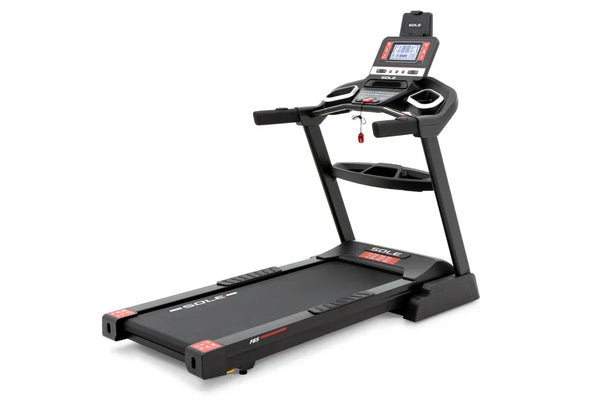
The numbered buttons on either side of the SOLE treadmill console let you change incline and speed mid-session without breaking stride.
Treadmill Walking Plans by Fitness Level
Beginner Treadmill Walking Plan
If you are new to regular exercise or coming back after a long break, build the habit before the intensity. Start with five sessions a week, 30 minutes each, at 3.0 to 3.5 mph on a flat belt or a slight incline.
After two weeks of hitting all five, add 10 minutes to your sessions or raise the incline a couple of levels. Change one at a time, so you know which adjustment your body is responding to.
Intermediate Treadmill Walking Plan
Once you have four to six weeks under your belt, aim for 200 to 250 minutes a week. A workable split is three 50- to 60-minute sessions at a moderate incline, plus two shorter 35-minute sessions at a brisker 3.8 to 4.2 mph on a flatter setting.
Sessions at this length are where a comfortable deck starts to matter more than the numbers on the console.
Experienced Treadmill Walking Plan
Once 250 minutes a week feels routine, more volume is what keeps results coming. ACSM puts clinically significant weight loss above that 250-minute mark, so this is the range worth working toward if fat loss is the goal rather than maintenance.
A six-day structure that gets you there: three 60-minute sessions at a moderate to steep incline, two 40- to 45-minute brisk sessions at 4.0 to 4.2 mph, and one longer easy walk of 60 to 75 minutes at conversational pace. That comes to roughly 320 to 345 minutes.
Two points matter more than the total at this level. First, keep one day genuinely easy; the long walk should feel like recovery, not another hard session, or the week catches up with you. Second, vary the incline rather than climbing every day; steep sessions load your calves and Achilles harder than flat walking, and back-to-back hill days are where people pick up niggles. Take a lighter week every fourth or fifth week and drop back to around 250 minutes.

Mixing longer moderate walks with shorter faster ones also makes the week easier to fit around a schedule, since not every session needs the same block of time.
How to Add Interval Walks & Core Work
You don't need to run to make a treadmill session harder, and you don't need a separate gym trip to train your abs. Intervals raise calorie burn and thin the fat layer; a few minutes of core work afterward builds the muscle underneath. Here is a sample session you can adjust to your own pace:
-
Warm up at 3.0 mph on a flat belt for 5 minutes.
-
Raise the incline and walk at 3.5 to 4.0 mph for 2 minutes. Stand tall, let go of the handrails, and keep your midsection braced rather than leaning into the console.
-
Lower the incline and walk at 3.0 mph for 90 seconds to recover.
-
Repeat the work-and-recovery cycle 6 to 8 times.
-
Cool down at 2.5 mph on a flat belt for 5 minutes.
-
Step off and finish with 5 minutes of core work: 3 rounds of a 30-second plank, 30 seconds of dead bugs, and 30 seconds of side planks per side, resting as needed.
With the core finisher, the whole session runs about 35 to 45 minutes, depending on how many cycles you do. Two or three of these a week alongside your steady walks is a practical way to raise your weekly effort without adding much time. The free SOLE+ app includes guided core and strength classes if you would rather follow along than count reps yourself.
Does Diet Affect Belly Fat Loss?
Walking burns calories, but it works alongside what you eat. You do not need a dramatic overhaul. Eating slightly less than you burn, consistently, does more over a few months than a strict plan you abandon in three weeks.
Protein is worth paying attention to. Reviews of controlled feeding studies have found that higher-protein diets preserve more lean mass during weight loss than lower-protein diets at the same calorie deficit, which means more of what you lose comes from fat. Lean meats, Greek yogurt, eggs, legumes, and protein shakes are all straightforward ways to get it.
Sugary drinks and processed snacks are the easiest place to start cutting. They add calories quickly without filling you up, which is what makes them easy to overeat without noticing.
Achieve Your Belly Fat Goals with SOLE’s Advanced Treadmill Technology

Most SOLE treadmills offer 0–15 power incline levels, and the TT8 extends to -6 for downhill work, so the interval and hill walks in any plan run on the same machine.
Walking reduces fat across your whole body rather than in one spot, so no amount of incline will target your midsection alone. Losing it comes down to the minutes you walk each week and how much you eat compared with what you burn. Incline and intervals help, but only once the weekly habit is in place.
We build our treadmills for the long, repeatable walks that actually get results, and the free SOLE+ app adds 3,000+ guided workouts, plus built-in console programs including Fat Burn and Strength. Cushion Flex decking absorbs the impact of each step, so your knees and ankles hold up across multiple sessions a week. Browse the SOLE treadmill range today.
Frequently Asked Questions (FAQs)
What treadmill speed burns the most belly fat?
No speed targets your midsection specifically, since fat comes off across your whole body rather than in one place. What matters is how many calories you burn, so the best pace is a brisk one you can hold for the whole session. Adding incline raises the effort without making you walk faster.
Does walking on an incline burn more belly fat than walking flat?
Incline walking burns more calories than flat walking at the same speed, which helps with fat loss overall. Your glutes, hamstrings, and calves work noticeably harder on a slope. None of that targets belly fat specifically, but it does make the same 30 minutes more productive.
How long does it take to see results from treadmill walking?
Most people feel changes in energy and sleep before they see anything in the mirror. Visible change usually takes a couple of months, depending on where you start, how consistent you are, and what you eat.
Should you walk on a treadmill every day to lose belly fat?
Daily walking is fine for most people, since brisk walking puts far less stress on your joints than running does. What causes problems is doing the same hard incline session seven days a week, which wears you down and eventually breaks the habit. Vary the effort instead, with a mix of longer easy walks and shorter harder ones.
Which SOLE treadmill is best for incline walking?
The SOLE TT8 Treadmill runs from -6 to 15 incline levels, using two separate motors so it can simulate downhill sections and climbs. On the SOLE F85 Treadmill, you get 0 to 15 levels with quick keys that jump straight to 0, 5, 10, or 15. For a lower price, the SOLE F63 Treadmill reaches the same 15 levels.
*Disclaimer: Products and prices mentioned in this article are accurate as of the date of publication and are subject to change. Please visit the official SOLE website for the most current information.