

Key Takeaways
- Backwards walking reduces knee joint stress while strengthening the quadriceps, particularly the vastus medialis (VMO), the teardrop-shaped muscle that stabilizes the kneecap.
- Research shows retro walking burns 40% more calories than forward walking at the same speed, making it efficient cardio that protects rather than punishes your joints.
- The ideal treadmill for backwards walking has a low step-up height, solid handrails, responsive speed controls, and incline capability.
- SOLE treadmills feature commercial-grade handrails and the Cushion Flex Whisper Deck for joint-friendly and safe backwards walking sessions.
Why Backwards Walking on a Treadmill Works
Physical therapists have prescribed retro walking for decades. This is because walking backwards on a treadmill shifts biomechanical stress away from the knee joint while demanding more work from the quadriceps.
When you walk forward, your heel strikes first and your knee absorbs significant impact. When you walk backward, your toe contacts the ground first, your knee straightens before loading, and the entire movement pattern reverses. The result is less compressive force on the knee, more muscular demand on the quads, and a training effect that builds rather than breaks down the joint.
But backwards walking isn't just rehabilitation. Athletes use it to strengthen muscles that forward movement neglects. The vastus medialis, which is the quad muscle most responsible for kneecap tracking, works harder during retro walking than almost any other exercise. Strong VMO equals stable, pain-free knees.
|
Award-Winning Commercial-Grade Treadmills for Your Home
Why Choose SOLE: ✓ Commercial-grade steel frames with up to 4.0 HP motors 30-Day Money-Back Guarantee: Love it or return it, no questions asked. |

The 3 Best Treadmills for Backwards Walking in 2026
SOLE TT8 — Maximum Stability for Serious Training

The TT8 is the treadmill physical therapists would design if they built equipment.
The TT8’s non-folding frame eliminates any possibility of wobble, which is critical when you're walking backwards and need absolute confidence in the surface beneath you.
The 8-inch step-up height makes mounting and dismounting easy, even when facing away from the controls. The commercial-grade handrails run the full length of the deck and support significant weight without flexing. The magnetic safety key clips cleanly to clothing and stops the belt within seconds.
What sets the TT8 apart for backwards walking is the 0% to 15% incline range and -6% decline range. Start with flat retro walking to learn the movement. Progress to a 5–10% incline as studies recommend for increased quad activation. Eventually, experiment with decline settings for advanced training variation.
The Cushion Flex Whisper Deck reduces joint impact by 40%, stacking with the biomechanical benefits of backwards walking for maximum knee protection. The 22" x 60" surface provides room for the slightly wider foot placement that retro walking naturally creates.
SOLE F85 — Complete Features With Folding Convenience

If your training space serves multiple purposes, this is the backwards walking treadmill to buy.
The F85 delivers everything the TT8 offers in a frame that folds for storage. Same 8-inch step-up height. Same Cushion Flex Whisper Deck with 40% impact reduction. Same 0–15% incline and -6% decline range for progressive retro walking training.. Same commercial-grade handrails running the length of the deck.
The folding mechanism uses Easy Assist hydraulics, where the deck lifts with minimal effort and lowers slowly and safely. When locked in position, the frame feels stable at any speed or incline. You sacrifice some rigidity compared to the non-folding TT8, but not enough to matter for walking-speed exercise.
The F85's 4.0 HP motor responds quickly to speed adjustments. This is useful when you're learning backward walking and need to slow down suddenly. The 15.6" touchscreen sits at eye level when you're facing it, allowing you to glance at speed and incline settings even while walking backwards. (You'll develop the proprioception to check less frequently as your balance improves.)
The 375-pound weight capacity handles most users with margin to spare. The lifetime frame and motor warranty provides indefinite protection.
SOLE F89 — Premium Display for Easier Monitoring

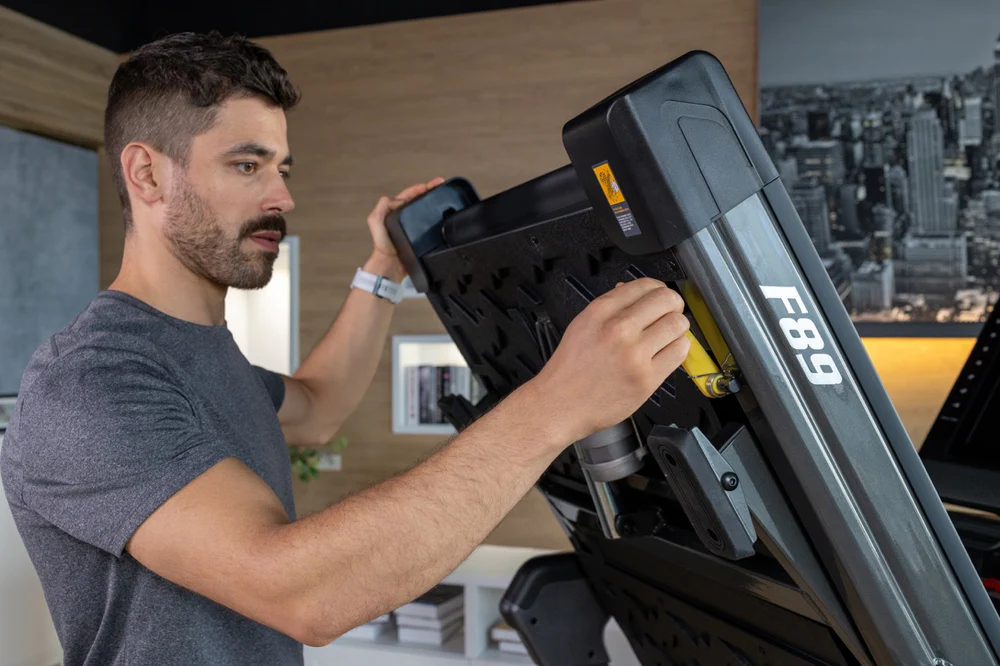
The F89 is SOLE's flagship folding treadmill, the same proven platform as the F85 with a screen upgrade that makes monitoring your backwards walking sessions significantly easier.
The F89’s 21.5" touchscreen dominates the console. When you're walking backwards and need to glance over your shoulder to check speed or incline, the larger display is genuinely easier to read. The Android-powered system runs the same streaming apps (Netflix, YouTube, Disney+) and SOLE+ workouts, just on a display with a larger diagonal screen size than the F85's.
Everything underneath matches the F85's specs exactly. The 4.0 HP motor. The 0–15% incline and -6% decline range for complete backwards walking progression. The 22" x 60" running surface. The Cushion Flex Whisper Deck with 40% impact reduction. The 8-inch step-up height. The commercial-grade handrails.
For backwards walking specifically, the bigger screen helps more than you'd expect. Checking settings requires looking over your shoulder or turning briefly, and a 21.5" display is readable in peripheral vision where a 15.6" display might not be. If visibility matters to you, or you simply want the best SOLE offers in a folding frame, the F89 delivers.
Top 3 Treadmills for Backwards Walking: Comparison Table
|
Feature |
SOLE TT8 |
SOLE F85 |
SOLE F89 |
|
Price |
$2,599.99 |
$2,299.99 |
$2,899.99 |
|
Step-up height |
8" |
8" |
8" |
|
Handrails |
Commercial-grade, full-length |
Commercial-grade, full-length |
Commercial-grade, full-length |
|
Incline |
0–15% |
0–15% |
0–15% |
|
Decline |
-6% |
-6% |
-6% |
|
Running surface |
22" x 60" |
22" x 60" |
22" x 60" |
|
Cushioning |
Whisper Deck (40% reduction) |
Whisper Deck (40% reduction) |
Whisper Deck (40% reduction) |
|
Frame stability |
Non-folding (maximum) |
Folding (excellent when locked) |
Folding (excellent when locked) |
|
Weight capacity |
400 lbs |
375 lbs |
375 lbs |
|
Safety key |
Magnetic quick-stop |
Magnetic quick-stop |
Magnetic quick-stop |
|
Motor |
4.0 HP |
4.0 HP |
4.0 HP |
|
Display |
15.6" touchscreen |
15.6" touchscreen |
21.5" touchscreen |
|
Frame warranty |
Lifetime |
Lifetime |
Lifetime |
|
Best for |
Maximum stability, serious training |
Full features at the best price |
Largest display, premium experience |
What Makes a Treadmill Good for Backwards Walking
Low Step-Up Height
Getting on and off a treadmill while facing backwards requires more coordination than normal mounting. A high deck makes this harder and riskier. The ideal step-up height for backwards walking is 8 inches or less; low enough to step onto comfortably without looking down.
Solid Handrails
During forward walking, handrails are optional. During backwards walking, they're essential at least until you've developed the balance and confidence to release them. The rails need to be sturdy enough to support your full weight if you stumble, and positioned where your hands naturally reach while facing the console.
Emergency Stop Access
The safety key becomes more important when you can't see the belt moving beneath you. It should clip to your clothing and stop the belt immediately if you drift too far back. Magnetic safety keys with easy attachment work better than clip-on designs that can snag.
Incline Capability
Research on backwards walking shows that incline increases quadriceps activation. A study in the Journal of Orthopaedic & Sports Physical Therapy found that walking backwards at 5% and 10% incline significantly changed knee and ankle joint positions, increasing the training effect on target muscles. A treadmill limited to flat walking leaves this progression unavailable.
Decline Capability
For advanced retro walking, decline adds another dimension. Walking backwards downhill (which means the treadmill is set to decline) creates different muscular demands and provides variety for long-term training. Few treadmills offer this, and it's a distinguishing feature worth seeking.
Cushioned Deck
Joint protection is often the reason people start backwards walking. A cushioned deck compounds the benefit, reducing impact forces beyond what the movement pattern already provides. Look for treadmills advertising 30%–40% impact reduction compared to outdoor surfaces.
Frame Stability
Backwards walking naturally involves more lateral movement and less predictable foot placement than forward walking. A stable, heavy frame prevents wobble and builds confidence. Non-folding designs are inherently more stable, though well-built folding treadmills can work fine.
Walk Backwards Into Stronger Knees
Backwards walking isn't a gimmick; it's a research-backed training method that physical therapists have used for decades. The movement reduces knee joint stress while strengthening the muscles that protect it. The calorie burn exceeds that of forward walking. The balance challenge builds proprioception that carries into every other movement you do.
The treadmill you choose determines whether retro walking feels safe or sketchy. Low step-up height matters when you're mounting the deck blind. Solid handrails matter while you're learning balance. Incline capability matters for progressive quad strengthening. Cushioning matters when joint protection is the whole point.
At SOLE, we built these features into every treadmill in our lineup. The commercial-grade handrails support your full weight without flexing. The Cushion Flex Whisper Deck reduces impact by 40%. The TT8, F85, and F89 all offer a -6% decline for advanced progressions.
Choose the TT8 for non-folding stability. Choose the F85 for the best value with full decline capability. Choose the F89 for the largest display and premium experience.
Then walk backwards. Your knees will thank you.
Frequently Asked Questions (FAQs)
Is backwards walking actually good for knees?
Yes. Multiple peer-reviewed studies confirm that retro walking reduces knee joint loading while strengthening the quadriceps, particularly the vastus medialis (VMO).
A 2019 randomized controlled trial found significant pain reduction and functional improvement in knee osteoarthritis patients after six weeks of backwards walking. Physical therapists routinely prescribe it for ACL rehabilitation, patellofemoral pain, and post-surgical recovery.
Do I need decline capability for backwards walking?
Not initially. Flat and inclined backwards walking provides plenty of training stimulus for months or years.
Decline becomes useful for advanced practitioners seeking variety or specific training effects; walking backwards on a decline creates different muscular demands than flat or inclined retro walking. The TT8, F85, and F89 all offer -6% decline capability.
Can I do backwards walking on any treadmill?
Technically, yes, but some treadmills work better than others. Key features include: low step-up height (8" or less), solid handrails for balance support, responsive speed controls for quick adjustments, incline capability for progressive training, and cushioned decks for joint protection.
Wobbly frames, high decks, or flimsy handrails make backwards walking unnecessarily difficult and potentially unsafe.
How often should I practice backwards walking?
Start with 2–3 sessions per week, 5–10 minutes each. Progress to 15–20 minutes as your balance and endurance improve. For knee rehabilitation, daily short sessions often work better than infrequent long ones. Listen to your body; backwards walking uses muscles and balance systems that forward walking neglects, so expect some initial fatigue and soreness.
Why is a low step-up height important?
When walking backwards on a treadmill, you mount the deck while facing away from the controls. A high step-up requires you to lift your leg behind you without seeing the surface, making it awkward and potentially unsafe.
An 8-inch step-up height like SOLE treadmills offers keeps the deck accessible without requiring exaggerated movements.
*Disclaimer: Products and prices mentioned in this article are accurate as of the date of publication and are subject to change. Please visit the official SOLE website for the most current information


Leave a comment
This site is protected by hCaptcha and the hCaptcha Privacy Policy and Terms of Service apply.