Key Takeaways
-
The elliptical moves your legs through a full oval path that bends the knees, while the glider swings your legs straight in a pendulum arc, so the two machines train your body differently.
-
The elliptical's biggest advantage is a full-body workout with adjustable resistance and incline, while the glider's biggest advantage is its lightweight, joint-friendly design and easy learning curve.
-
The elliptical's main downside is its higher cost and larger footprint, while the glider's main downside is a low resistance ceiling that causes gains to plateau quickly.
-
At SOLE Fitness, we offer a range of high-grade ellipticals, all made with heavy-duty steel frames, with adjustable stride and incline, and come with free access to our SOLE+ app for instructor-led workouts.
*Note: SOLE does not manufacture or sell glider machines. This is an independent review of a product for comparison purposes.
How Elliptical & Glider Motion Differs
Ellipticals and gliders both offer low-impact cardio, but they work your body in noticeably different ways. The elliptical follows a smooth, oval-shaped path that bends and extends your legs through a fuller range of motion.
A glider, on the other hand, keeps your legs relatively straight and swings them forward and back in a pendulum-like arc. That single mechanical difference changes the muscles targeted, the intensity achievable, and who each machine is actually best for.
Both machines belong to the low-impact category, since your feet stay planted and there is no jarring ground contact, which is why either can work for sensitive knees. Where they part ways is intensity and reach: the elliptical adds resistance and incline so it can keep growing with you, while the glider keeps things light and easy from start to finish.
|
Smooth, Natural Motion for Every Body. Top-Rated Home Fitness Ellipticals!
Why Choose SOLE Ellipticals: ✓ Whisper-quiet eddy current resistance system 30-Day Money-Back Guarantee: Love it or return it, no questions asked. |

What Is an Elliptical Machine?
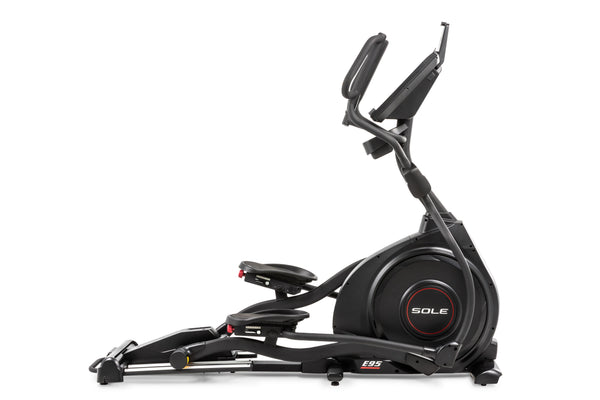
An elliptical trainer is a stationary cardio machine where your feet move along a fixed, oval-shaped (elliptical) track. Unlike a treadmill, your feet never leave the pedals, which reduces impact on your knees, hips, and ankles.
Most modern ellipticals, like the SOLE E35 or SOLE E25, include moving handlebars that engage your upper body simultaneously, turning it into a full-body workout. You can also adjust resistance levels and incline to increase workout intensity as your fitness improves.

An elliptical typically features resistance and incline adjustments, hand grips, and glide rails.
What Is a Glider Machine?
A glider exercise machine, sometimes called an air glider or cross glider, works by allowing your legs to swing forward and back in a wide arc while your feet stay close to the ground.
Gliders typically have long handlebars that move with your arms, allowing for some upper body engagement. The motion is fluid, low-resistance, and closely mimics a natural walking or striding pattern without the bend and push of a true elliptical path.
Elliptical vs Glider: The Core Differences
Range of Motion
The elliptical guides your legs through a full oval path; your knees bend, your hips extend, and your stride length stretches out. Some ellipticals let you adjust the stride length to match your height and workout style. The SOLE E35, for example, features an adjustable incline of up to 20 levels, letting you shift the emphasis between quads, hamstrings, and glutes mid-workout.
On the other hand, the glider keeps your legs much straighter. The motion is more of a sweeping pendulum than a controlled stride. This limits how deeply the lower body muscles are engaged but also makes the movement feel smoother and less demanding for those just starting out.
Muscles Worked
The elliptical engages a broader muscle group with greater activation depth. When you push through the pedals and drive the handlebars, you're recruiting quadriceps, hamstrings, glutes, calves, core, chest, back, and arms.
The glider also works the legs and arms, but with less intensity and a shallower range of muscle recruitment. It's effective for light toning and general cardiovascular conditioning, particularly in the hip flexors, inner thighs, and shoulders, especially when you vary your stride width as the glider’s design encourages.

Working out with an elliptical targets major muscle groups such as calves, back, and arms, while getting your heart rate up.
Impact on Joints
The elliptical qualifies as low-impact, but the deeper knee bend and greater range of motion mean slightly more joint load than a glider. For most people with knee concerns, this is still well within a safe and comfortable range, especially compared to running or stair climbing.
The glider is arguably the gentler of the two. Because the legs stay relatively straight and the motion is a smooth, arc-based swing, there's almost no compressive force on the knees. This makes it a strong option for people with arthritis, knee replacements, or early-stage rehabilitation needs.
Intensity & Resistance
Most ellipticals offer adjustable magnetic resistance levels. The SOLE E25 features 20 resistance levels, while the SOLE E98 adds power incline adjustment across 40 resistance levels, letting you dial in intensity with precision. You can simulate uphill climbs, increase stride difficulty, or drop resistance for active recovery, all within the same workout session.
Gliders offer far less programmable resistance. Most models rely on your own body momentum and stride speed to control intensity. Some higher-end gliders include basic tension adjustments, but nothing close to the range an elliptical provides.
Elliptical Pros & Cons
Pros of Using an Elliptical
-
Scalability: A beginner can set resistance to level 1 and glide comfortably, while an experienced athlete can crank up resistance and incline to build serious cardiovascular and muscular endurance. That flexibility makes it a machine you won't outgrow.
-
Fully engaging workout: The dual-action handlebars on most ellipticals also make it a true full-body workout. Pushing and pulling through the arms while driving through the legs means your chest, back, biceps, and triceps are all contributing. For people short on time who want cardiovascular and muscular conditioning in one session, that's a major efficiency win.
Cons of Using an Elliptical
-
Cost and size: Quality ellipticals take up a meaningful footprint in a home gym, and entry-level models that feel smooth and durable start at a higher price point than most gliders. Budget machines often wobble, have short stride lengths that don't suit taller users, and offer limited resistance ranges that limit long-term usefulness.
-
Learning curve: There's also a learning curve for some users. Getting the stride motion to feel natural takes a few sessions. It's not complicated, but first-timers sometimes find the coordination slightly awkward before it clicks.
Glider Pros & Cons
Pros of Using a Glider
-
Lightweightness: Gliders are lightweight and easy to use. The motion is intuitive, requiring almost no learning curve, and the ultra-low joint impact makes it accessible to seniors, post-surgical users, and complete beginners who need to ease into regular movement.
-
Movement variety: Some gliders support at least six distinct exercise positions, including wide glide, low glide, forward push, and balance gliding without holding the bars. That kind of movement variation keeps workouts from becoming monotonous and allows you to subtly target different muscle groups within the same session.
Cons of Using a Glider
-
Low progression ceiling: Once you've built a base level of fitness on a glider, it becomes difficult to continue progressing. The limited resistance range means your cardiovascular system adapts quickly, and without the ability to meaningfully increase the challenge, calorie burn and fitness gains plateau.
-
Shallow muscle recruitment: Compared to the elliptical, the glider also falls short in muscle engagement depth. The shallower range of leg motion means your quads, hamstrings, and glutes aren't being pushed through their full functional range. Over time, this limits the strength and endurance benefits you can extract from the machine.
-
Less calorie burn: Since most published calorie-burn research focuses on ellipticals and treadmills, it's harder to quantify the exact metabolic output of a glider session, though it's generally accepted to be lower than an elliptical at equivalent effort levels.
Elliptical vs Glider: Comparison Table
|
Feature |
Elliptical |
Glider |
|
Range of Motion |
Full elliptical path, knees bend and extend |
Pendulum arc, legs stay mostly straight |
|
Muscles Worked |
Full body, legs, glutes, core, arms, back |
Legs, hip flexors, inner thighs, shoulders |
|
Joint Impact |
Low impact |
Very low impact |
|
Resistance Levels |
Up to 40+ levels with incline options |
Minimal, mostly body momentum |
|
Best For |
All fitness levels, progressive training |
Beginners, seniors, rehabilitation |
|
Size & Storage |
Larger footprint, limited portability |
Lightweight, often foldable |
Choose an Elliptical That Grows With You at SOLE Fitness

SOLE ellipticals include Bluetooth connectivity, built-in speakers, and free access to the SOLE+ app for instructor-led workouts.
Ellipticals and gliders both deliver low-impact cardio, so the right choice depends on where you are and where you want to go. A glider is a comfortable entry point for gentle, joint-friendly movement, but its limited resistance means most people outgrow it. An elliptical asks a little more coordination and space, yet it rewards you with a fuller-body workout and the room to keep pushing as your fitness climbs.
If you want a machine that stays with you for the long haul, SOLE Fitness ellipticals are designed with a quiet resistance system, adjustable pedals, a heavy-duty steel frame, and customizable incline levels that fit every height. Browse our elliptical range today and try yours risk-free with a 30-day money-back guarantee.
Frequently Asked Questions (FAQs)
What are the disadvantages of using an elliptical?
The main disadvantages of an elliptical are its size, cost, and the fact that it doesn't replicate natural ground-contact movement like walking or running. Quality ellipticals require a significant footprint in a home gym, and budget models often cut corners on stride length, frame stability, and resistance smoothness.
What is the difference between a glider and an elliptical?
The core difference between a glider and an elliptical is the movement path and range of motion. A glider keeps your legs mostly straight, swinging them forward and back in a wide pendulum arc with minimal knee bend. An elliptical guides your feet through a full oval-shaped path, bending and extending your legs through a much greater range of motion that more closely mimics a running or cycling stride.
Is an elliptical safe for bad knees?
Yes, an elliptical is generally considered one of the safest cardio options for people with knee problems. Because your feet stay in contact with the pedals throughout the entire movement, there's no impact or jarring force transmitted through the knee joint. The smooth, guided elliptical motion actually distributes load evenly across the knee, which is far less stressful than running, jumping, or even aggressive stair climbing.
Which is better for weight loss, elliptical or walking?
The elliptical generally burns more calories than walking at a comparable time investment. It also engages the upper body simultaneously, increasing overall metabolic output without adding extra time to your workout. For weight loss specifically, the elliptical has a higher calorie-burn ceiling and greater workout variety, both of which matter for long-term consistency and results.
What warranty does SOLE Fitness offer on ellipticals?
At SOLE Fitness, our ellipticals are backed by strong, long-term coverage, with our premium models like the E95 carrying a lifetime frame and flywheel warranty, three years on parts, electronics, and magnetic brake, and one year on labor. Exact terms vary by model, with entry-level machines covered for shorter periods on parts and labor. For the precise warranty on the model you're considering, check its product page, where the full coverage is listed alongside the specs.
*Disclaimer: Products and prices mentioned in this article are accurate as of the date of publication and are subject to change. Please visit the official SOLE website for the most current information.