

Key Takeaways
- Exercise bikes typically burn significantly more calories per hour than flat walking, with the gap varying widely based on resistance, cadence, and the individual's effort level, though incline walking on a treadmill closes this gap substantially.
- Cycling is completely non-weight-bearing, making it the strongest choice for individuals with significant joint issues, those recovering from lower-body injuries, or people carrying substantial excess weight.
- Walking engages more total muscle groups, including glutes, hamstrings, and core stabilizers, more meaningfully than cycling, which emphasizes quadriceps dominantly through the pedaling motion.
- The exercise you enjoy and will perform consistently produces better weight loss results than the theoretically superior option you avoid, and many people achieve the strongest results by combining both.
- The SOLE SB1200 delivers commercial-quality indoor cycling with a 35-pound flywheel and 100 resistance levels, while the SOLE F80 treadmill supports incline walking with 15% maximum grade and Cushion Flex Whisper Deck cushioning.
Exercise Bike vs Walking for Weight Loss: Which Is Better?
Exercise bikes are usually better for weight loss if you want lower-impact cardio with higher workout intensity, while walking is better if you want the simplest routine to start and sustain. Incline walking can close the calorie-burn gap, but cycling may be easier on the joints because your body weight stays supported by the seat.
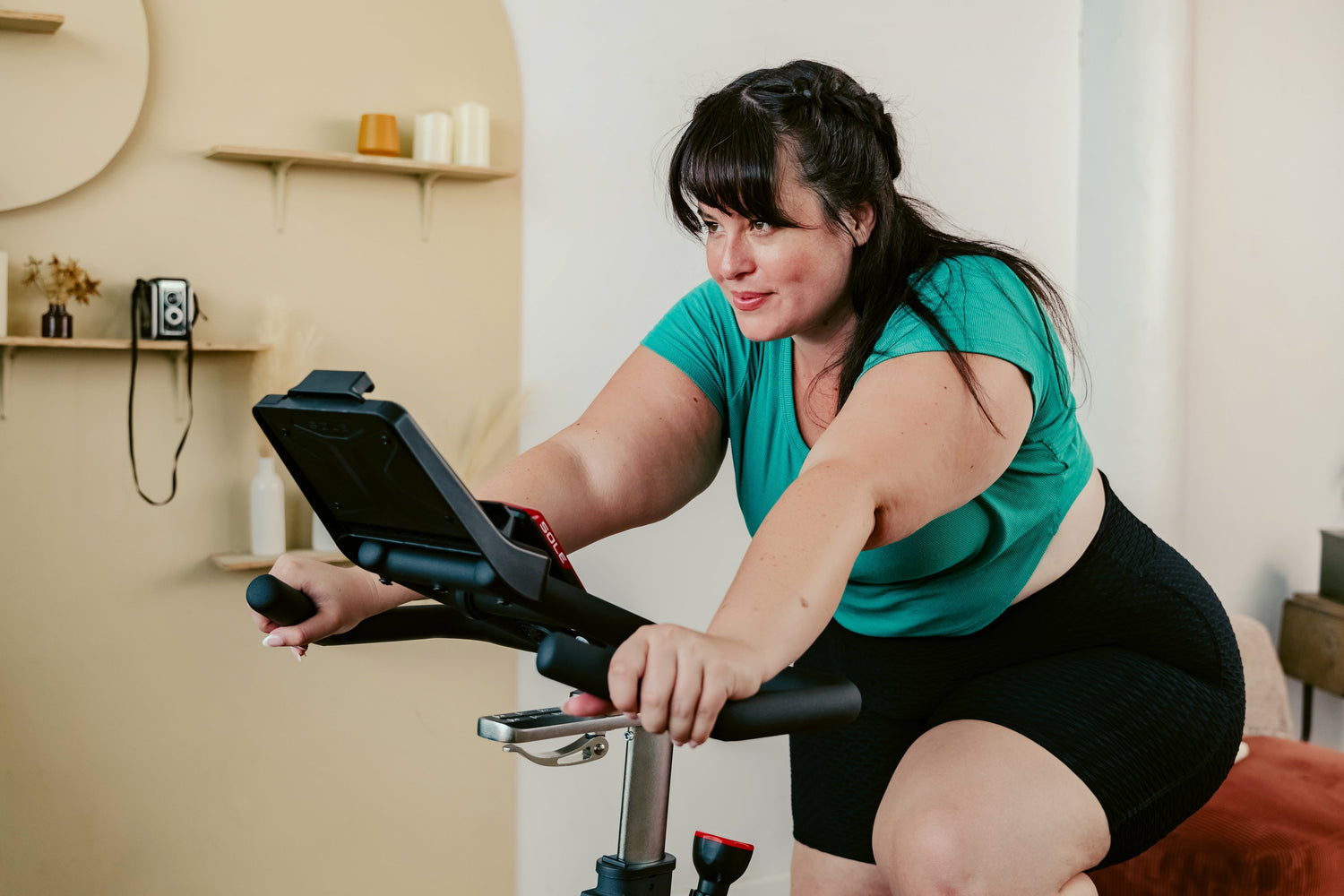
The SOLE SB1200 supports the cycling side with a 35-pound flywheel and 100 resistance levels, which is a good fit for users who want controlled, higher-intensity rides without repeated foot impact. The SOLE F80 treadmill fits walkers who want to use incline training to raise intensity without switching to running.
This article covers calorie burn, muscle engagement, joint impact, bike types, and how to combine both for the strongest long-term results.
|
Smooth, Silent Rides for Every Fitness Level. Premium Home Fitness Bikes!
 Choose Your Perfect Style:
Why Choose SOLE Exercise Bikes: ✓ Whisper-quiet magnetic resistance won't disturb others 30-Day Money-Back Guarantee: Love it or return it, no questions asked. |
How Many Calories Do Exercise Bikes & Walking Actually Burn?

Calorie expenditure varies based on intensity, incline, and body weight, with cycling and incline walking producing comparable results at the higher end of effort.
Exercise Bike Calorie Burn
Stationary bike calories vary based on resistance level, cadence (RPM), and whether you are seated or standing. Typical ranges for a 155-pound person:
|
Intensity |
Calories/30 min |
Calories/Hour |
|
Light (easy pedaling, low resistance) |
150 to 180 |
300 to 360 |
|
Moderate (steady effort, moderate resistance) |
210 to 260 |
420 to 520 |
|
Vigorous (high resistance, fast cadence) |
300 to 370 |
600 to 740 |
|
HIIT intervals (alternating max and recovery) |
280 to 350 |
560 to 700 |
Spin bikes and indoor cycling bikes typically enable higher intensities than recumbent bikes due to standing capability and aggressive positioning. Upright bikes fall between these extremes.
Walking Calorie Burn
Walking calories depend heavily on speed and incline. Flat walking burns fewer calories than most people realize:
|
Activity |
Calories/30 min |
Calories/Hour |
|
Slow walk (2.0 MPH, flat) |
90 to 110 |
180 to 220 |
|
Moderate walk (3.0 MPH, flat) |
120 to 150 |
240 to 300 |
|
Brisk walk (3.5 MPH, flat) |
140 to 175 |
280 to 350 |
|
Fast walk (4.0 MPH, flat) |
165 to 200 |
330 to 400 |
|
Incline walk (3.5 MPH, 10% grade) |
200 to 250 |
400 to 500 |
|
Incline walk (3.5 MPH, 15% grade) |
240 to 300 |
480 to 600 |
Which Muscles Do Exercise Bikes and Walking Work?

Cycling emphasizes the quadriceps through the pedaling motion, while walking distributes effort across the glutes, hamstrings, calves, and core in a natural movement pattern.
Exercise Bike Muscle Engagement
Cycling mainly works the front of your legs, especially the quadriceps. These muscles do much of the work during the downward push of each pedal stroke, which is why exercise bikes are often a strong choice for building leg endurance and strength.
The hamstrings, hip flexors, and glutes also help move the pedals, but they usually play a smaller role than the quadriceps. Your core helps keep your body steady, especially during harder rides or standing climbs.
Your arms and upper body mostly provide support on the handlebars rather than working against resistance. Because of this, cycling is strongest for the quads, provides some glute and hamstring work, and offers limited upper-body engagement compared with full-body cardio options.
Walking Muscle Engagement
Walking works your legs and core in a more balanced way than cycling. Your glutes, hamstrings, quads, and calves all help move you forward, while your core helps keep your body steady with each step.
Incline walking increases the work for your glutes and hamstrings because your legs have to push harder to move uphill. Your arms swing naturally, but they do not work against resistance, so walking still provides very little upper-body training.
Muscle Development Implications for Weight Loss
More muscle engagement generally means more calories burned, both during exercise and at rest. Walking's broader muscle recruitment may provide a slight metabolic advantage, though cycling's ability to achieve higher intensities can offset this.
For body composition goals beyond weight loss, cycling may be better for building quad strength and endurance, while walking, especially incline walking, may do more for the glutes and hamstrings. Walking also trains a more natural movement pattern, which can carry over well to daily activities like climbing stairs, carrying groceries, or walking longer distances.
How Do Exercise Bikes & Walking Compare for Joint Impact?

Both exercises protect joints far better than running, with cycling eliminating both impact and weight-bearing stress while walking remains low-impact for most users.
Exercise Bike: Low-Impact, Non-Weight-Bearing Cardio
Cycling eliminates both impact and weight-bearing stress, which makes it the gentlest cardio option for joints. Cycling produces no impact forces through the knees, hips, or ankles. The body weight is supported by the saddle rather than the legs, the motion is smooth and circular without sudden direction changes, and resistance can be adjusted to minimize joint stress while maintaining effort.
This combination is particularly valuable for knee osteoarthritis (cycling is often prescribed as therapeutic exercise), hip replacements or hip arthritis, ankle injuries or instability, significant excess weight, post-surgical rehabilitation, and chronic pain conditions.
The main concerns are that a prolonged seated position may aggravate lower back issues for some users, saddle discomfort is common until proper fit is established, and very high resistance can stress knees if form breaks down.
Walking: Low-Impact, Weight-Bearing Cardio
Walking produces ground reaction forces of approximately 1.0 to 1.5 times body weight with each step, far less than running at 1.5 to 3.0 times, but not zero. Impact is present but manageable for most people. Weight-bearing stimulates bone density maintenance, which cycling does not provide.
Surface matters, as concrete is harder than trails or treadmill decks, and cushioned shoes and treadmill decks reduce impact further. Incline reduces impact while decline increases it. Walking is valuable for general fitness with normal joint health, bone density maintenance (where weight-bearing exercise is essential), functional movement pattern reinforcement, and for individuals who tolerate walking without pain.
The concerns are that walking may aggravate existing knee, hip, or ankle problems, higher body weight increases impact forces proportionally, hard surfaces multiply joint stress, and long durations accumulate impact over many steps.
Summary Table: Exercise Bike vs Walking For Weight Loss
|
Factor |
Exercise Bike |
Walking |
|
Calorie Burn (moderate, 155-lb person) |
420 to 520 per hour |
280 to 350 per hour (flat), 480 to 600 per hour (15% incline) |
|
Muscle Emphasis |
Quadriceps-dominant, moderate glutes |
Glutes, hamstrings, calves, core stabilization |
|
Upper Body Activation |
Minimal |
Minimal |
|
Joint Impact |
Zero |
Low (1.0 to 1.5x body weight per step) |
|
Weight-Bearing |
No |
Yes (supports bone density) |
|
Learning Curve |
Short, plus saddle adjustment period |
None |
|
Weather Dependence |
None (indoor) |
High (outdoor), none (treadmill) |
|
Best For |
Joint sensitivity, time efficiency, and multitasking |
Beginners, bone health, functional fitness, social exercise |
|
SOLE Recommendation |
SB1200, LCB, LCR |
F80, F65 |
Note: Calorie figures are based on a 155-pound individual at moderate intensity.
Exercise Bike vs Walking: Which Should You Choose For Your Weight Loss Goals?
The choice between an exercise bike and walking for weight loss depends less on calorie mathematics and more on what your joints will tolerate and what you will actually do consistently. Cycling suits individuals who prioritize time efficiency, complete joint protection, indoor consistency, and the ability to multitask while training. Walking, particularly on an incline treadmill, suits individuals who want functional movement, bone density support, lower upfront cost on the equipment side, and the option to integrate exercise into daily life through outdoor walks.
The right home equipment can make the choice easier to follow through on. For cycling, the SOLE SB1200 supports higher-intensity indoor rides with a 35-pound flywheel and 100 resistance levels. For walking, the SOLE F80 gives you a treadmill option for incline training, so you can raise workout intensity without switching to running. Together, they support the two main paths in this comparison: seated cycling for lower-impact cardio and incline walking for a
Shop the SOLE collection today!
Frequently Asked Questions (FAQs)
Is cycling or walking better for belly fat?
Neither targets belly fat specifically, as spot reduction is a myth. Both create calorie deficits that lead to overall fat loss. Genetics determines where your body loses fat first, and exercise selection does not change this. Choose the exercise you will do consistently, as that consistency determines total fat loss, including abdominal.
Can I lose weight with just an exercise bike?
Yes. Consistent cycling creates calorie expenditure that supports weight loss when combined with appropriate nutrition. Many people have lost significant weight using only stationary bikes. Add resistance progression and interval training to maximize results.
How long should I exercise for weight loss: cycling vs walking?
Aim for 150 to 300 minutes weekly of moderate cardio regardless of type. At moderate intensity, 30 minutes of cycling roughly equals 40 to 45 minutes of flat walking in calories. With incline walking, the durations become similar. Exercise at whatever duration you can sustain consistently.
Will cycling make my legs bulky?
No. Building significant leg muscle requires heavy resistance training, calorie surplus, and often years of dedicated effort. Cycling for weight loss, which involves moderate resistance and calorie deficit, tones legs without adding bulk.
Is an exercise bike or walking better for seniors?
Both work well for seniors; the choice depends on individual circumstances. Recumbent bikes offer stability and back support beneficial for many seniors. Walking maintains bone density and functional movement patterns. Many seniors benefit from both, using the bike when joints are stiff and walking when feeling good.
Disclaimer: Products and prices mentioned in this article are accurate as of the date of publication and are subject to change. Please visit the official SOLE website for the most current information.


Leave a comment
This site is protected by hCaptcha and the hCaptcha Privacy Policy and Terms of Service apply.