Key Takeaways
-
SOLE includes 3,000+ guided classes through the free SOLE+ app with no subscription, Keiser includes lifetime FTP-zone training on its Studio models with no recurring fee, and Peloton locks its full class library behind a $49.99/month All-Access membership.
-
SOLE’s touchscreen bikes start at $1,699.99 with no recurring costs, Keiser ranges from $2,660 to $3,490, and a first-year Peloton Cross Training Bike with All-Access totals roughly $2,295 before the monthly bill keeps running.
-
The SOLE LCB and LCR support riders up to 350 lb and offer both upright and recumbent frames; Keiser’s M Series supports indoor cycling only, and Peloton caps rider weight at 297 lb with no recumbent option.
-
SOLE owners highlight quiet magnetic resistance and responsive customer support; Keiser riders praise resistance quality, but note manual-only adjustment; and Peloton users value live classes but flag billing and hardware service issues.
-
SOLE backs every bike with a lifetime frame warranty, free curbside shipping, and a 30-day satisfaction guarantee, so the purchase price is the full cost of ownership from day one.
How Membership Fees Change the Long-Term Cost of a Home Bike
The purchase price on a product page is the number most shoppers compare, but it is the least accurate predictor of what a home bike actually costs over two or three years. Peloton’s Cross Training Bike starts at $1,695, which looks lower than Keiser’s $2,660 entry point, until $49.99/month in All-Access fees pushes the Peloton past the Keiser by the end of year two and keeps climbing every month after.
Keiser avoids that recurring cost entirely, bundling lifetime access to The Ride’s FTP-zone training with its Studio and Studio Plus models. The tradeoff is a higher upfront price, with the top model reaching $3,490, roughly double what SOLE charges for a touchscreen bike with comparable resistance depth.
SOLE avoids both trade-offs. The LCB and LCR stream 3,000+ free SOLE+ workouts on their 10.1-inch touchscreens at $1,699.99, with no membership to activate and nothing added to the price over time. That makes SOLE the lowest total cost of the three at every point past the purchase date.
*Note: SOLE does not manufacture or sell the Keiser or Peloton bikes. This is an independent review of a product for comparison purposes.
|
Smooth, Silent Rides for Every Fitness Level. Premium Home Fitness Bikes!
 Choose Your Perfect Style: Why Choose SOLE Exercise Bikes: ✓ Whisper-quiet magnetic resistance won't disturb others 30-Day Money-Back Guarantee: Love it or return it, no questions asked. |
Keiser vs Peloton vs SOLE Bikes: Features & Specs
SOLE Fitness Bikes

The SOLE LCB's multi-grip handlebars let riders shift hand positions during longer rides, easing pressure on the wrists and shoulders.
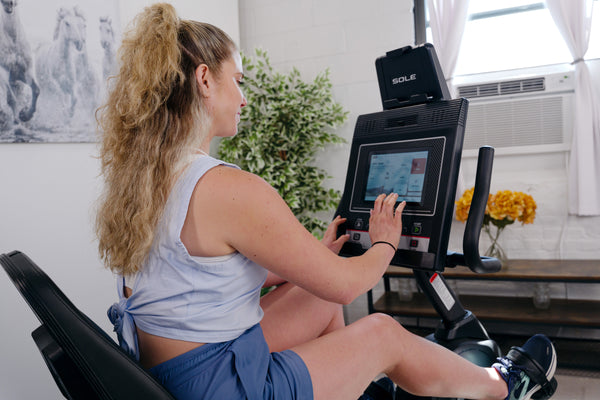
SOLE's cycling lineup includes one upright touchscreen model and three recumbent options, each built around the free SOLE+ app instead of a paid subscription.
-
LCB (upright): 40 magnetic resistance levels, 31-pound flywheel, 10.1-inch touchscreen, 350-pound weight capacity.
-
LCR (recumbent): 40 EMS magnetic resistance levels, 31-pound flywheel, 10.1-inch Android touchscreen with screen mirroring, 350-pound weight capacity.
-
R98 (recumbent): 20 ECB magnetic resistance levels, 20 lb flywheel, 10.1-inch tilting touchscreen with preloaded streaming apps, 15-position mesh seat, 300 lb weight capacity.
-
R92 (recumbent): 20 eddy-current resistance levels, 20-pound flywheel, white LED console, 300-pound weight capacity.
All four models support Bluetooth speakers and connect to SOLE+ for workout data. The LCB and LCR go further with Wi-Fi and wireless charging.
Keiser Bikes

The Keiser M3i places its gear shifter on the handlebars, so riders can change resistance mid-ride without breaking position. (Image source: Keiser)
Keiser's indoor-cycling range spans four models that share the same self-tensioning Poly-V belt and rear-flywheel layout. The M3 is the entry point, with manual magnetic resistance and a standard console that shows cadence, power, heart rate, ride time, gear, and distance, but no Bluetooth connectivity.
The M3i adds the M Connect display with Bluetooth transmission for cadence, watts, and heart rate. The M3i Studio steps up to the Studio Display, with 72 gears, color-coded intensity zones, and lifetime access to The Ride's FTP-zone cycling content.
The M3i Studio Plus tops the range with four-way handlebar adjustment, the only feature that separates it from the M3i Studio's two-way adjustment. Both Studio models share the Studio Display's ANT+ and Bluetooth support, and dual-sided pedals for standard shoes or SPD cleats are standard across the M Series.
Peloton Bikes

The Peloton Cross Training Bike fits into a compact footprint of about 4 by 2 feet, making it a practical fit for smaller rooms. (Image source: Peloton)
Peloton's current new-bike range centers on two models built for a swiveling touchscreen experience. The Cross Training Bike uses manual resistance, a 21.5-inch Full HD touchscreen, Bluetooth 5.2, and front-facing speakers, with pedals that require Delta-compatible cleats.
The Cross Training Bike+ adds automatic resistance that follows instructor cues, a larger 23.8-inch touchscreen, a cooling fan, Sonos-tuned speakers, and a movement-tracking camera that supports applicable strength workouts. Budget-conscious shoppers can also consider the refurbished Original Bike and Original Bike+, though these carry different specifications than the current lineup.
How Much Do Keiser, Peloton & SOLE Bikes Cost?
SOLE Fitness Pricing
SOLE prices its bikes well below both competitors while keeping touchscreen functionality on three of its four models. The LCB and R98 sell for $1,699.99, the LCR for $1,999.99, and the R92 for $1,299.99. None of these prices require an ongoing subscription to unlock full functionality.
Keiser Pricing
Keiser's four-model lineup climbs steadily as features are added. The M3 starts at $2,660, the M3i at $2,985, the M3i Studio at $3,320, and the M3i Studio Plus tops the range at $3,490. Studio and Studio Plus purchases include lifetime access to The Ride's FTP-zone cycling content.
The Studio Plus bundle also throws in a floor mat, tool kit, media tray, and stretch pads. Buyers comparing Keiser to SOLE should note that Keiser's pricing sits roughly double SOLE's touchscreen models, even before factoring in any membership costs.
Peloton Pricing
Peloton's current bikes list at $1,695 for the Cross Training Bike and $2,695 for the Cross Training Bike+. Refurbished units cost less: $1,145 for the Original Bike and $1,395 for the Original Bike+, though these carry older specifications than the current range.
The bigger cost driver is membership. All-Access runs $49.99 per month plus applicable taxes, which adds $599.88 annually to the hardware price. A first-year Cross Training Bike purchase with All-Access totals roughly $2,294.88 before taxes, while the Bike+ equivalent reaches about $3,294.88, both figures excluding accessories or additional services.
Keiser vs Peloton vs SOLE Bikes: User Reviews
SOLE Fitness Reviews
SOLE bike owners often single out how quietly the magnetic resistance runs, letting them train without disturbing others at home. Recumbent owners, including older riders, describe the R92 as easy to use and gentle on the joints. Several reviews also mention SOLE's support team responding quickly by phone or email when questions came up.
Keiser Reviews
Keiser owners describe the M3i as quiet, demanding in resistance, and easy to adjust for different riders sharing one machine. The main recurring qualification is the manual resistance lever, which requires riders using third-party cycling apps to adjust difficulty themselves rather than relying on automatic control.
Peloton Reviews
Peloton owners frequently point to the instructors and live class format as the reason they keep riding years after purchase. The convenience of exercising at home, paired with workout variety, shows up repeatedly in positive feedback. Broader complaints about Peloton include billing issues, slow communication, and difficulty resolving hardware problems.
Keiser vs Peloton vs SOLE Bikes: Comparison Table
|
Feature |
SOLE |
Keiser |
Peloton |
|
Models |
LCB, R92, R98, and LCR |
M3, M3i, M3i Studio, and M3i Studio Plus |
Cross Training Bike and Bike+ |
|
Riding position |
Upright LCB; recumbent R92, R98, and LCR |
Indoor cycling |
Indoor cycling |
|
Price |
$1,299.99 R92 to $1,999.99 LCR |
$2,660 M3 to $3,490 M3i Studio Plus |
$1,695 Bike; $2,695 Bike+ |
|
Display |
White LED console on R92; 10.1-inch touchscreen on LCB and LCR |
Standard console on M3; M Connect on M3i; Studio Display on Studio models |
21.5-inch touchscreen on Bike; 23.8-inch on Bike+ |
|
Resistance |
20 levels on R92/R98; 40 levels on LCB and LCR |
Manual magnetic; 72 gears on Studio models |
Manual on Bike; automatic on Bike+ |
|
Connectivity |
Bluetooth on all models; Wi-Fi on LCB and LCR |
Bluetooth on M3i; ANT+ and Bluetooth on Studio models |
Bluetooth 5.2 |
|
Monthly fee |
None |
None |
$49.99 All-Access for classes |
|
Training content |
Free SOLE+ app with 3,000+ instructor-led workouts |
Lifetime FTP-zone training from The Ride on Studio models |
Live and on-demand classes with All-Access |
|
Reviews |
Quiet rides and quick support stand out |
Quiet and demanding, though app riders must shift resistance manually |
Instructors keep riders loyal, while billing and service draw complaints |
SOLE Bikes Provide Lasting Durability & Free Classes for Riders
Choosing between these three brands comes down to which matters most for your routine: ongoing membership costs, automatic resistance, or upfront price. Peloton's Bike+ automates resistance but requires a monthly membership, while Keiser's commercial-grade cycles start well above SOLE's prices. SOLE delivers guided classes and lasting durability without either tradeoff.
We built the LCB, R98, R92, and LCR with lifetime frame warranties and free access to 3,000+ SOLE+ workouts. The LCB and LCR meet light commercial standards with a 350-pound capacity, while the R92 and R98 support riders up to 300 pounds. Shop our bikes today, with our 30-day satisfaction guarantee giving you a month to decide.
Frequently Asked Questions (FAQs)
Is Keiser or Peloton better for home workouts?
It depends on what the rider values most. Keiser suits riders who want precise resistance control and minimal recurring costs, since its bikes include lifetime content access with qualifying purchases. Peloton suits riders who prioritize live instruction and a large on-demand class library, provided they're comfortable with the ongoing $49.99 monthly All-Access fee.
Is SOLE a good alternative to Peloton?
Yes, for riders who want touchscreen functionality without a required subscription. SOLE's LCB and LCR models include 10.1-inch touchscreens and free SOLE+ access with over 3,000 instructor-led workouts, priced at $1,699.99 and $1,999.99 respectively, both well below Peloton's current hardware and membership costs combined.
Does the Keiser M3i require a subscription?
No. The M3i uses the M Connect display to track cadence, watts, and heart rate without a required subscription. Riders who want structured cycling content can access The Ride's FTP-zone library included with qualifying Studio and Studio Plus purchases, not a recurring membership fee.
Do Peloton bikes work without an All-Access membership?
Peloton bikes function without All-Access, but the touchscreen's full class library remains locked without it. App One ($12.99 monthly, or $15.99 billed through the Apple App Store) and App+ ($28.99 monthly) offer mobile workout content but don't unlock the bike's built-in touchscreen experience, which requires the $49.99 monthly All-Access plan.
How long do SOLE exercise bikes last?
SOLE exercise bikes are built for years of regular home use, and their warranty terms reflect that. SOLE backs its LCB and LCR bikes with a lifetime frame warranty, three years of electronics and parts coverage, and one year of labor coverage for residential use. The R92 and R98 carry lifetime frame coverage with two years on electronics and parts and one year on labor.
*Disclaimer: Products and prices mentioned in this article are accurate as of the date of publication and are subject to change. Please visit the official SOLE website for the most current information.