Key Takeaways
-
Treadmills are weight-bearing machines that send force through your bones with every step, while recumbent bikes support you in a reclined seat with the pedals out in front.
-
Impact exercise on a treadmill helps maintain or improve bone strength, and adjustable speed and incline let one machine handle anything from a recovery walk to interval runs.
-
Recumbent bikes protect the joints, since pedaling moves the legs through their full range of motion, boosts lubricating synovial fluid, and builds leg and core muscles that support them.
-
A treadmill suits bone density or race training goals, while a recumbent bike suits people managing arthritis, recovering from joint surgery, or dealing with back, shoulder, or balance issues.
-
SOLE Fitness makes both types, including the F63 and F80 treadmills and the R92 and LCR recumbent bikes, with the LCR adding a full back-support seat and a 15.6-inch touchscreen.
Weight-Bearing vs Seated Cardio
Treadmills place force through your bones and joints with every step, while recumbent bikes remove that impact almost entirely by supporting your body in a reclined, seated position. Many shoppers assume one machine simply burns more calories than the other, but the real decision usually comes down to how your joints and bones handle repeated impact.
The stakes rise further for anyone with a diagnosed bone or joint condition. Someone managing osteoporosis can use impact exercise to help maintain or improve bone strength, yet the Royal Osteoporosis Society advises anyone with spinal fractures or many broken bones to stick with low-impact options, such as walking, rather than jogging or jumping.
A person recovering from knee surgery, on the other hand, may find a recumbent bike a comfortable way to ease back into cardio, with their doctor’s or physical therapist’s approval, before returning to a treadmill. Matching the machine to the condition, not just the fitness goal, is where many buying decisions go wrong.
|
Premium Home Gym Equipment with Award-Winning Quality! Complete Your Home Gym:
Why Choose SOLE: ✓ Commercial-grade quality for home use 30-Day Money-Back Guarantee: Love it or return it, no questions asked. |

What Are Treadmills and Recumbent Bikes?
What Are Treadmills?
A treadmill is a weight-bearing machine, meaning you stay on your feet and your body absorbs force every time a foot strikes the belt. Treadmills let you adjust speed and incline, so the same machine can deliver a gentle walk or a demanding run depending on the settings you choose.
What Are Recumbent Bikes?
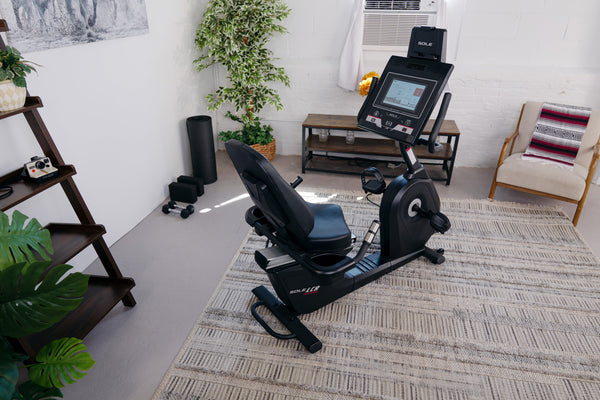
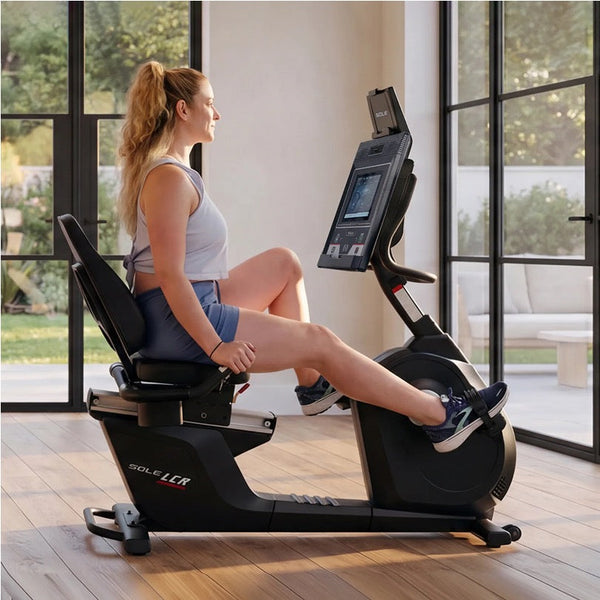
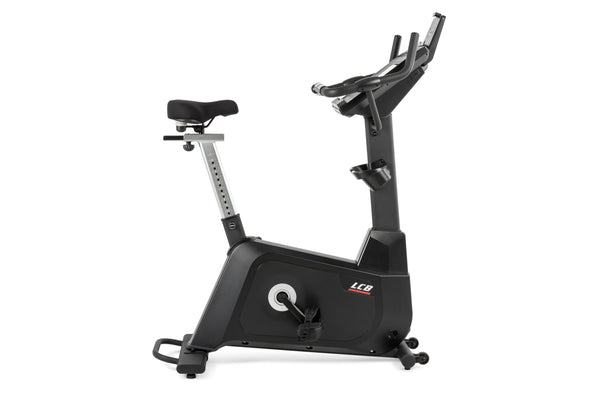
A recumbent bike seats you in a reclined position with a wider seat and a backrest, and the pedals sit out in front of your body instead of underneath it. Upright bikes have you lean forward to hold the handlebars, which can be uncomfortable for people with back, shoulder, or wrist issues. The recumbent design avoids that by letting the seat and backrest carry your weight.
Treadmill vs Recumbent Bike: Key Differences

Treadmills make you carry your full body weight, while recumbent bikes support you in a seat for steadier, balance-friendly workouts.
Load on the Body
The biggest difference between these two machines comes down to how they load the body. A treadmill requires you to stay upright and bear your full body weight with every stride, while a recumbent bike supports your weight in the seat and backrest, leaving your legs to do the work without carrying your frame.
Stability
Stability is another major split. Recumbent bikes keep both feet in a fixed position with a low center of gravity, which removes the balance demands that come with walking or running on a moving belt.
This is part of why a physical therapist cited by the Arthritis Foundation calls recumbent bikes a better option for people with balance or mobility issues. The seated, supported position makes it easier to keep good posture, which puts less pressure on the spine and hips.
Treadmill vs Recumbent Bike Benefits
Treadmill Benefits
-
According to the Royal Osteoporosis Society, impact exercise such as walking, stair climbing, jogging, and dancing helps maintain or improve bone strength. Walking or jogging on a treadmill delivers that same kind of impact.
-
The Society also notes that combining impact exercise with strength training is the best way to build bone strength. That makes a treadmill a natural pairing with resistance work.
-
Adjusting speed and incline means the same machine can deliver a gentle recovery walk one day and a high-intensity interval run the next.
-
Running at 7.5 mph burns about 525 calories in 30 minutes for a 185-pound person, according to Harvard Health Publishing figures.
Recumbent Bike Benefits
-
A physical therapist cited by the Arthritis Foundation describes stationary biking as an ideal low-impact exercise for people with arthritis.
-
Pedaling moves the legs through their full range of motion and encourages the production of synovial fluid that lubricates the joints. See our guide to the best recumbent bikes for bad knees for models to consider.
-
Biking builds core and leg muscle, and stronger muscles help support the joints and take pressure off them.
Best Use Cases for a Treadmill

Treadmills suit runners preparing for races and anyone building stronger bones, with walking, jogging, and incline work possible in one session.
People focused on bone health or running performance often lean toward a treadmill. A treadmill fits best for people who are:
-
Prioritizing bone density, since impact exercise, especially when paired with strength training, can help maintain or improve bone strength.
-
Training for running events and needing to hold a set pace through bad weather, dark evenings, or a busy schedule.
-
Looking for flexibility within a single workout, such as warming up at a 3.5 mph walk, building to a 5 mph jog, and finishing with incline-based strength work without switching equipment.
Best Use Cases for a Recumbent Bike
The seated, supported position allows consistent movement without the impact or instability of weight-bearing cardio. A recumbent bike fits best for people who are:
-
Managing arthritis, since the seated position lets the joints move through their range of motion with less pressure on the hips and spine.
-
Recovering from joint surgery and easing back into cardio, with their doctor’s or physical therapist’s approval, at a low resistance they can build up gradually.
-
Dealing with back, shoulder, or balance issues that make standing exercise uncomfortable.
Treadmill vs Recumbent Bike: Comparison Table
|
Feature |
Treadmill |
Recumbent Bike |
|
Body position |
Upright, weight-bearing |
Seated, reclined with back support |
|
Impact level |
Low to moderate impact (walking to running) |
Low-impact, non-weight-bearing |
|
Joint stress |
Higher, loads knees, hips, and ankles |
Minimal, supported by seat and backrest |
|
Balance demand |
Requires standing balance and coordination |
Minimal, feet stay fixed on pedals |
|
Bone density benefit |
Supports bone strength through impact |
No direct bone-loading effect |
|
Best suited for |
Bone health, versatile cardio, running training |
Joint pain, arthritis, rehab, balance issues |
Protect Your Joints and Reach Your Fitness Goals with SOLE

From weight-bearing treadmills to joint-friendly recumbent bikes, SOLE Fitness offers machines that help you train consistently at home.
Whichever machine fits your body and goals, consistency matters more than intensity. Showing up several days a week on equipment that respects your joints and bones, while still challenging your cardiovascular system, is what turns a home gym purchase into a lasting habit.
SOLE Fitness carries both weight-bearing treadmills, including the F63 and F80, and joint-friendly recumbent bikes like the R92 and LCR, so you don’t have to guess which category fits your body before committing. The F80 also features SOLE’s CushionFlex Whisper Deck, which reduces joint impact by up to 40%. See the full SOLE Fitness lineup and find the machine built for where your body is today.
Frequently Asked Questions (FAQs)
Is a recumbent bike as good as a treadmill for weight loss?
It depends more on intensity than on the machine. Harvard Health Publishing figures show a 185-pound person burns about 294 calories in 30 minutes of moderate stationary cycling, compared with 189 for walking at 4 mph and 525 for running at 7.5 mph. Raising the resistance closes some of that gap.
Is a recumbent bike or treadmill better for bad knees?
A recumbent bike is generally the gentler choice for bad knees, because the seat carries your weight instead of your knees absorbing each stride. A 2021 systematic review in Clinical Rehabilitation, which pooled 11 trials, found stationary cycling reduced pain and improved sport function in people with knee osteoarthritis compared with no exercise.
Can you use both a treadmill and a recumbent bike?
Yes, and alternating between them can cover both goals. Treadmill days add the impact that bones respond to, while recumbent bike days let you keep training when joints feel sore or are still recovering. This mix also varies the muscles you work, which can make a routine easier to stick with.
How long should you ride a recumbent bike with arthritis?
The Arthritis Foundation suggests aiming for about 20 minutes a day, 3 to 5 days a week. You don’t have to do it all at once: a physical therapist quoted by the Foundation notes you can ride for five minutes at a time. Start at a slow pace with no added resistance, and build up from there. A recumbent bike’s supported seat can make these short, frequent sessions more comfortable on sore joints.
Does SOLE Fitness make both treadmills and recumbent bikes?
Yes. SOLE Fitness makes treadmills such as the F63 and F80, and recumbent bikes such as the R92 and LCR. The R92 offers a back-supported mesh seat and 20 resistance levels, while the LCR adds a 15.6-inch tilt-and-swivel touchscreen, 40 levels of EMS resistance, and a 350 lb weight capacity.
*Disclaimer: Products and prices mentioned in this article are accurate as of the date of publication and are subject to change. Please visit the official SOLE website for the most current information.