

Key Takeaways
- Treadmills typically burn more calories per minute (approximately 9.3) compared to rowing machines (7.6).
- Rowing machines provide a full-body workout engaging about 86% of your muscles across legs, core, back, shoulders, and arms, while treadmills primarily target lower body muscles with minimal upper body involvement.
- For joint health, rowing machines offer lower-impact exercise with virtually zero vertical impact forces, while treadmill running creates repetitive impact that can aggravate knee, hip, or ankle issues in some users.
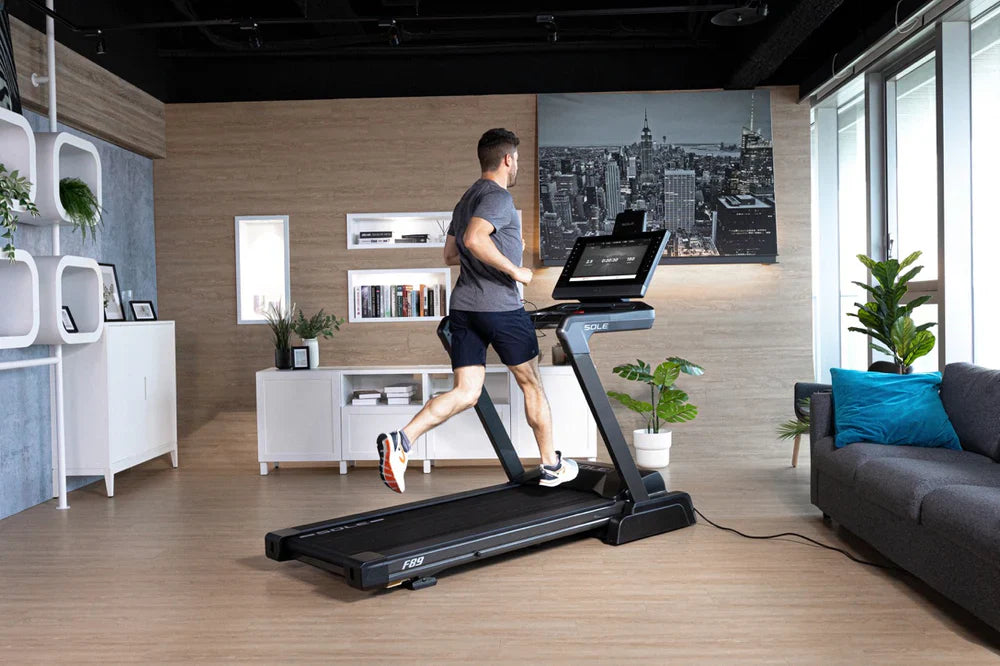
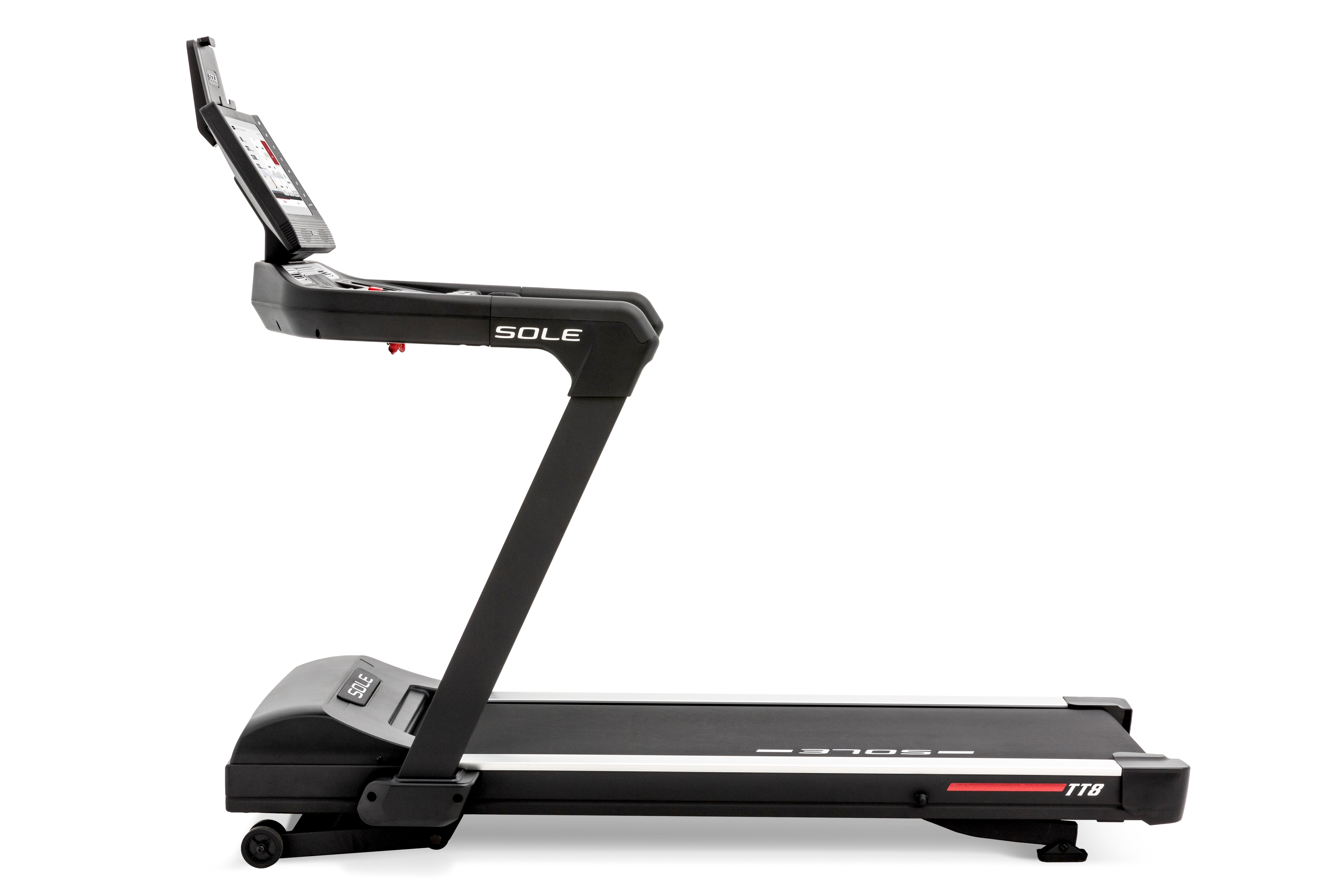
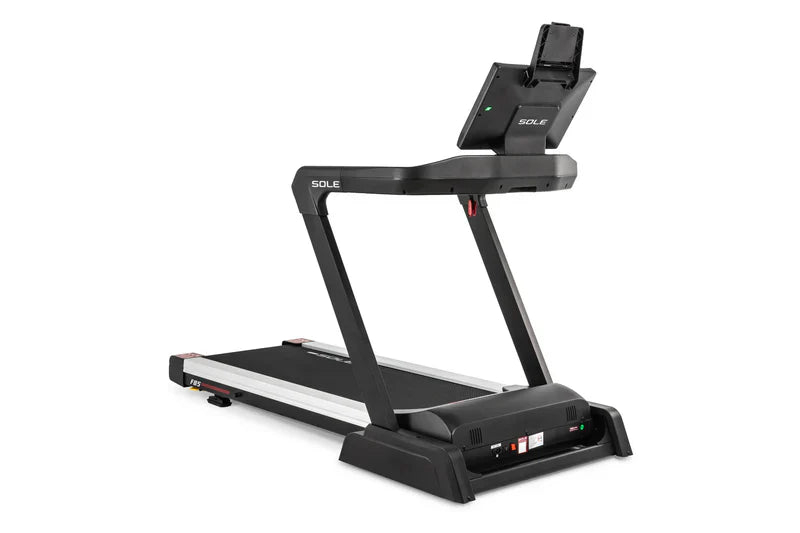
- SOLE Treadmills maximize calorie burn while our SOLE Rowing Machines provide full-body conditioning.
The Truth About Burning Calories: Treadmill vs Rowing Machine
When comparing calorie burn, research gives treadmills a slight edge in pure numbers. A 2019 study from the University of Wisconsin-La Crosse, published in the International Journal of Research in Exercise Physiology, found that treadmill users burn approximately 9.3 calories per minute compared to 7.6 calories per minute on rowing machines at similar perceived exertion levels.
This difference adds up to approximately 51 extra calories during a 30-minute session. However, rowing activates approximately 86% of your muscles, creating a comprehensive workout that builds strength while improving cardiovascular fitness. While treadmills primarily engage the lower body with minimal upper-body involvement, they are excellent for cardiovascular endurance but less effective for total-body conditioning.
So which one actually helps you lose weight faster? The answer depends on more than just raw calorie numbers. This guide breaks down the details, compares real-world numbers, and helps you decide which machine aligns with your goals, body, and lifestyle.
|
Premium Home Gym Equipment with Award-Winning Quality! Complete Your Home Gym:
Why Choose SOLE: ✓ Commercial-grade quality for home use 30-Day Money-Back Guarantee: Love it or return it, no questions asked. |

Treadmill Calorie Burn

Treadmills have earned their reputation as calorie-burning powerhouses by tapping into our most natural movement pattern while allowing precise control over speed and resistance.
The Natural Movement Advantage
Treadmills have earned their reputation as calorie-burning powerhouses by tapping into our most instinctive movement pattern. Walking and running require no technical instruction, making treadmills immediately accessible to exercisers of all experience levels.
This simplicity translates to consistent, effective workouts from day one. Additionally, treadmills offer precise control over two key variables—speed and incline—allowing you to fine-tune intensity and progressively challenge your cardiovascular system as your fitness improves.
Calories Burned Per 30 Minutes Using a Treadmill (185 lb person)
- Walking at 3.5 mph: 178 calories
- Running at 5 mph: 336 calories
- Running at 6 mph: 356 calories
- Running at 7.5 mph: 448 calories
- Running at 8 mph: 459 calories
How Speed & Incline Affect Burn Rate
The treadmill's secret weapon lies in adjustable settings. Increasing speed delivers obvious benefits, but adding incline creates a multiplier effect.
Even a modest 2% incline can increase calorie burn by 3–5%, while a challenging 15% incline can nearly double caloric expenditure compared to flat running at the same speed.
This incline advantage targets posterior chain muscles more intensively while reducing impact forces on joints.
HIIT vs Steady-State
A 2019 study in the British Journal of Sports Medicine found that HIIT produced 28.5% greater reductions in total absolute fat mass than moderate-intensity continuous training.
HIIT involves alternating between intense effort, such as sprinting, and recovery periods, creating an afterburn effect in which your body continues burning calories for up to 24 hours post-workout.
Rowing Machine Calorie Burn

Rowing machine's full-body engagement promotes physiological adaptations that benefit long-term weight management and body composition.
The Full-Body Advantage
Unlike most cardio machines that focus on isolated muscle groups, rowing machines deliver a comprehensive workout in every single stroke. The movement engages approximately 86% of your body's muscles, making it one of the most efficient exercises available.
Each rowing stroke follows four distinct phases, and the power distribution tells the story of why this exercise is so effective. Your legs do the heavy lifting, generating roughly 60% of the total force as they drive against the footplates.
Your core contributes the next 20%, stabilising your torso and transferring power from your lower body to your upper body. Finally, your arms and back complete the stroke with the remaining 20%, pulling the handle toward your chest.
This coordinated effort means you're not just burning calories—you're building functional strength across multiple muscle groups simultaneously.
Calories Burned by Intensity Using A Rowing Machine (185 lb person, 30 minutes):
- Moderate rowing: 222 calories
- Vigorous rowing: 316 calories
- Race pace rowing: 481 calories
The Role of Proper Technique
Poor form not only reduces energy expenditure but also increases injury risk. The proper sequence, such as legs, core, arms on the drive; arms, core, legs on the recovery, ensures optimal muscle recruitment and mechanical efficiency. Common technical mistakes can reduce calorie burn by up to 20%.
Why Intensity Matters
At low intensity (20–24 strokes per minute), rowing might burn 400–450 calories per hour. Increasing to moderate intensity (24–28 strokes per minute) elevates this to 600–700 calories, while high-intensity rowing (28–36+ strokes per minute) can exceed 800–1000 calories per hour for conditioned athletes.
How to Maximize Calorie Burn on Either Machine
Optimal Treadmill Workouts
The treadmill's versatility allows for several highly effective workout styles, each suited to different goals and fitness levels.
Interval training remains one of the most efficient ways to burn calories. A typical session involves 30 seconds of near-maximum effort running followed by 90 seconds of walking recovery, repeated for 20–30 minutes. By alternating between high-intensity bursts and active rest, you keep your heart rate elevated while giving your body brief recovery windows before the next push.
For those who prefer a steadier challenge, the incline pyramid offers an excellent alternative. Start at a modest 2% incline while maintaining a challenging pace, then gradually increase to 12% before working your way back down. This progressive approach targets your lower body muscles more intensively as the incline rises, all while keeping your cardiovascular system fully engaged throughout the session.
Steady-state training takes a different approach entirely. Rather than fluctuating between intensities, you maintain 70–80% of your maximum heart rate for 45–60 minutes. This sustained effort encourages your body to use fat as its primary fuel source, making it particularly effective for longer, endurance-focused sessions.
Rowing Intervals That Torch Calories
Rowing lends itself naturally to interval-based training, and two formats stand out for their calorie-burning potential.
The Tabata protocol packs maximum intensity into minimal time. Each round consists of 20 seconds of all-out rowing followed by just 10 seconds of rest, repeated for 8 rounds—a total of only 4 minutes. After a 1-minute recovery, you repeat the cycle for 4–6 sets. Despite its brevity, this format delivers remarkable calorie burn and metabolic benefits.
Pyramid intervals offer a more gradual intensity curve. Begin by rowing hard at 85–90% of your maximum effort for 1 minute, followed by 1 minute of easy recovery. Then extend the hard interval to 2 minutes while keeping the recovery at 1 minute, and continue building to 3 minutes of hard rowing before reversing the pattern.
This structure progressively challenges your endurance while providing strategic recovery periods that help you maintain quality effort throughout.
Combining Both
Consider structuring your week with two treadmill days for lower body conditioning, two rowing sessions for full-body integration, and one cross-training day incorporating both machines in a circuit format.
Which Machine Fits Your Weight Loss Goals?

Selecting between a treadmill and a rowing machine ultimately depends on aligning equipment with your specific objectives, physical condition, and personal preferences.
Best Choice for Beginners
For beginners, treadmills provide the gentlest learning curve with a natural walking motion that requires minimal technical instruction. Most treadmills also offer handrails for stability during early workouts, helping new exercisers build confidence.
Ideal for Joint Issues
Rowing machines provide a fundamentally lower-impact form of exercise with virtually zero vertical impact forces. The seated position distributes body weight through the pelvis rather than the legs. However, individuals with lower back issues should approach rowing cautiously.
Winner for Muscle Tone
Rowing machines clearly outperform treadmills in developing visible muscle tone throughout the body. The rowing stroke actively engages quadriceps, hamstrings, glutes, core, back, shoulders, and arms.
Space Considerations
Space considerations may also influence your decision. Treadmills typically require a 7-foot by 3-foot footprint, while rowers need approximately 8 feet by 2 feet during use. However, many rowing machines offer vertical storage, reducing their footprint to just 2 feet by 2 feet.
Treadmill vs Rowing Machine for Weight Loss: Comparison Table
|
Factor |
Treadmill |
Rowing Machine |
|
Calories/Minute (avg) |
~9.3 |
~7.6 |
|
Calories/30 Min (moderate) |
336 (running 5 mph) |
222 (moderate rowing) |
|
Calories/30 Min (vigorous) |
448 (running 7.5 mph) |
316 (vigorous rowing) |
|
Calories/30 Min (max effort) |
459+ (running 8+ mph) |
481 (race pace) |
|
Muscle Activation |
~40% (lower body focus) |
~86% (full body) |
|
Primary Muscles |
Quads, hamstrings, glutes, calves |
Legs (60%), core (20%), upper body (20%) |
|
Upper Body Engagement |
Minimal |
Significant (back, shoulders, arms) |
|
Core Engagement |
Moderate (increases with incline) |
High (force transfer every stroke) |
|
Joint Impact |
High (running), Moderate (walking) |
Very low (zero vertical impact) |
|
Bone Density Benefits |
Excellent (weight-bearing) |
Minimal |
|
Best for Knee Issues |
Walking only (no running) |
Excellent (seated, low-impact) |
|
Best for Back Issues |
Generally safe |
Use caution (spinal flexion) |
|
HIIT Suitability |
Excellent |
Excellent |
|
Afterburn Effect (EPOC) |
High |
High |
|
Muscle Building |
Low (lower body only) |
Moderate (full body) |
|
Metabolic Rate Increase |
Moderate |
Higher (more muscle engagement) |
|
Learning Curve |
Low (natural walking/running) |
Moderate (technique matters) |
|
Technique Impact on Burn |
Low |
High (poor form reduces burn 20%) |
|
Incline/Resistance Options |
Speed + 15 incline levels |
Resistance settings |
|
Calorie Multiplier Options |
15% incline nearly doubles the burn |
Stroke rate + resistance |
|
Space Required |
~7' x 3' |
~8' x 2' (vertical storage: 2' x 2') |
|
Best For |
Maximum calorie burn, runners |
Full-body conditioning, joint protection |
Maximize Your Weight Loss Results With SOLE
Both treadmills and rowing machines offer powerful tools for weight loss, each with distinct advantages. SOLE Treadmills delivers the calorie-burning efficiency that makes treadmills the weight loss weapon of choice.
The SOLE SR550 Rowing Machine attacks weight loss from a different angle—full-body muscle engagement that transforms your metabolism. The dual air and magnetic resistance system provides smooth, consistent tension at any intensity, from fat-burning steady-state rows to HIIT intervals that trigger a serious afterburn effect.
Together, these machines create a weight-loss system that prevents adaptation plateaus that stall progress. Use the treadmill for maximum calorie burn on high-intensity days.
Switch to the rower for full-body conditioning that builds muscle while protecting your joints. Alternate between them to keep your body guessing and your metabolism elevated.
The free SOLE+ App tracks workouts on both machines without subscription fees.
Shop the SOLE collection today!
Frequently Asked Questions (FAQs)
How many calories can I burn in 30 minutes on a treadmill?
Calorie burn varies significantly based on weight, speed, and incline. For a 185-pound person, walking at 3.5 mph burns approximately 178 calories in 30 minutes, while running at 6 mph burns 356 calories.
Does rowing build muscle while burning fat?
Yes, rowing machines excel at simultaneous muscle development and fat burning. The rowing stroke engages approximately 86% of your body's musculature, creating resistance-training effects, particularly in the posterior chain (back, glutes, hamstrings) and core, while simultaneously elevating heart rate enough to burn significant calories.
How often should I use a treadmill or rower for weight loss?
Aim for 3–5 cardio sessions per week, totaling 150–300 minutes, depending on intensity. HIIT may require fewer sessions (3–4 weekly) with more recovery, while moderate-intensity steady-state can be performed more frequently (4–6 times weekly). Beginners should start with 2–3 weekly sessions and gradually increase the frequency.
What equipment supports comprehensive weight loss training?
Effective weight-loss training benefits from having both treadmill and rowing options to provide workout variety and prevent adaptation plateaus. SOLE Treadmills maximize calorie burn through speed and incline intervals, while responsive cushioning reduces joint impact.
The SOLE SR550 Rowing Machine with dual air and magnetic resistance provides full-body conditioning engaging 86% of muscles for simultaneous strength building and calorie burning.
Disclaimer: Products and prices mentioned in this article are accurate as of the date of publication and are subject to change. Please visit the official SOLE website for the most current information.


Leave a comment
This site is protected by hCaptcha and the hCaptcha Privacy Policy and Terms of Service apply.