Key Takeaways
-
A cross trainer combines running, cycling, and stair-climbing motions into one fluid movement, using active moving arm handles that engage the upper body alongside the legs.
-
An elliptical simulates the natural arc of walking or running with minimal impact, often features stationary handles, and draws primary drive from the glutes, hamstrings, quads, and calves.
-
Cross trainers offer more upper-body engagement, higher calorie-burn potential, and greater workout variety, while ellipticals take up less space and have a gentler learning curve.
-
Cross trainers suit full-body conditioning and intermediate users, while ellipticals fit beginners, joint recovery, older adults, and anyone with limited space.
-
At SOLE Fitness, we offer a range of ellipticals with whisper-quiet resistance, a lifetime frame warranty, and access to the SOLE+ app for instructor-led workouts.
Cross Trainer vs. Elliptical: How Do They Differ?
Cross trainers and ellipticals are often used interchangeably, but a few differences in arm movement, pedal motion, and muscle engagement can change your entire workout. A cross trainer prioritizes full-body conditioning with actively powered upper-body handles, letting you work your chest, shoulders, arms, and back while training your lower body.
On the other hand, an elliptical prioritizes smooth, steady leg-driven cardio with a smaller footprint and a shorter learning curve. Both machines deliver low-impact cardio, but they move your body, engage your muscles, and fit into your workout space differently.
The right pick depends on your training goals, available space, and how much upper-body work you want in every session.
|
Smooth, Natural Motion for Every Body. Top-Rated Home Fitness Ellipticals!
Why Choose SOLE Ellipticals: ✓ Whisper-quiet eddy current resistance system 30-Day Money-Back Guarantee: Love it or return it, no questions asked. |

Cross Trainer vs. Elliptical: An Overview
What Is a Cross Trainer?
A cross trainer is a cardio machine that combines the movement patterns of running, cycling, and stair climbing into one fluid motion. The defining feature is the moving arm handles. You push and pull them in sync with your leg stride, engaging your chest, back, shoulders, and arms alongside your lower body.
Cross trainers typically offer a larger range of motion than standard ellipticals. The stride is longer and more varied, so more muscle groups stay engaged through each stride. For people who want to maximize their time on a machine, that added engagement is a significant advantage.
What Is an Elliptical Machine?

Many ellipticals come with handles, but on basic models those handles are stationary or only lightly engaged.
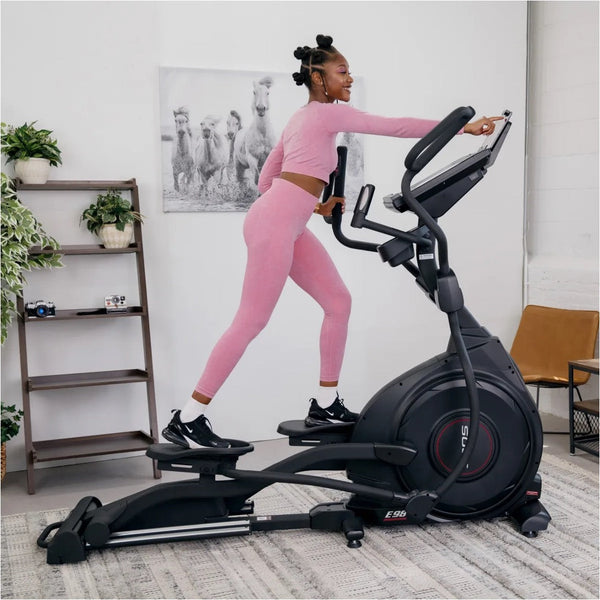
An elliptical machine simulates the natural arc of walking or running while keeping impact to a minimum. Your feet trace an oval-shaped path, so your joints avoid most of the jarring compression they would experience on a treadmill or pavement.
Your legs do the heavy lifting: your glutes, hamstrings, quads, and calves. This makes the elliptical an incredibly approachable machine for beginners, older adults, and anyone managing knee, hip, or ankle issues.
Ellipticals are also more compact than cross trainers in most cases. The learning curve is minimal, and the motion feels natural almost immediately.
Cross Trainer vs. Elliptical: The Core Differences
Upper Body Involvement

Moving arm handles, standard on cross trainers and found on many modern ellipticals, let you engage your upper body as you stride.
Cross trainers have moving arm handles that actively engage your upper body. Used correctly, they work your biceps, triceps, shoulders, chest, and upper back while you train your lower body.
Basic ellipticals, by contrast, feature fixed handles that are there for balance rather than propulsion. Many modern ellipticals close this gap by pairing moving arm handles with stationary grips. If upper-body conditioning is part of your goal, choose a cross trainer or an elliptical with moving arm handles.
Pedal Motion & Foot Placement
On an elliptical, your feet follow a consistent, predictable oval path. It's smooth, controlled, and feels similar to walking or light jogging. Cross trainers often offer a wider range of motion.
Some models let you adjust stride length, add incline, or even reverse pedal direction to shift emphasis to different muscle groups. That versatility makes cross trainers better for people who want to target specific areas or keep workouts from getting repetitive.
Size, Footprint, & Space Requirements
Cross trainers, with their extended arm mechanisms and longer stride rails, tend to require more floor space, both in length and width.
Ellipticals are generally more compact. Their fixed handles and contained pedal motion mean they don't need as much space. If you're working with a spare bedroom, apartment corner, or shared garage gym space, an elliptical usually fits more easily.
Intensity & Resistance Options
Both machines offer resistance settings that let you dial the difficulty up or down, but cross trainers tend to give you more ways to adjust intensity. Variable stride length, adjustable incline, and moving-arm resistance add layers of challenge that a standard elliptical can't always match.
Ellipticals still offer intensity options, though. Many modern ellipticals include magnetic resistance systems with 20 or more levels, power-adjustable incline, and pre-programmed interval workouts.
The SOLE E95 elliptical, for example, offers 20 resistance levels and a 20-level power incline, giving users a surprisingly deep range of training intensity without the complexity of a full cross-trainer setup.
Calorie Burn & Cardio Performance
For raw calorie burn, cross trainers have the advantage, but only when you're actively using the arm handles. Full-body engagement means more muscles working at once, and more muscles working means more energy expended.
A passive rider who leans on the handles and lets their legs do all the work on a cross trainer will burn no more than someone on a standard elliptical.
Cross Trainer vs. Elliptical: Best Use Cases
-
Cross Trainer: Best for people targeting full-body conditioning, intermediate to advanced gym-goers, those wanting workout variety, and anyone looking to maximize calorie burn per session.
-
Elliptical: Best for beginners, people with joint pain, older adults, those who want simple low-impact steady-state cardio, and anyone with limited space.
-
Either machine works well for: Cardiovascular fitness improvement, weight management, active recovery days, and building aerobic endurance.
Cross Trainer vs. Elliptical: Summary Table
|
Feature |
Cross Trainer |
Elliptical |
|
Upper Body Engagement |
High: active moving handles |
Low: mostly stationary handles |
|
Joint Impact |
Low impact |
Low impact |
|
Calorie Burn Potential |
Higher (full-body use) |
Moderate (lower-body focused) |
|
Space Required |
More floor space needed |
More compact |
|
Beginner Friendly |
Moderate learning curve |
Very beginner friendly |
|
Workout Variety |
High: variable stride, incline, arm resistance |
Moderate: resistance and incline options |
|
Best For |
Full-body conditioning, maximum calorie burn per session |
Joint recovery, steady cardio, beginners |
Choose The Right Machine For Your Goals at SOLE Fitness

SOLE Fitness offers a range of high-grade ellipticals, all backed by a 30-day satisfaction guarantee.
If you want joint-friendly cardio with a gentle learning curve, an elliptical is your answer. If you're ready to push harder, engage your whole body, and keep your workouts from going stale, a cross trainer delivers that extra edge. The key is picking the machine you will actually use consistently, not the one that looks best on paper.
At SOLE Fitness, we build ellipticals and cross trainers engineered for the consistency serious home users need, with whisper-quiet eddy-current resistance and heavy-duty steel frames that support up to 400 lbs. Every purchase includes a lifetime frame warranty and access to the free SOLE+ app for instructor-led workouts at no subscription cost. Shop SOLE Fitness ellipticals today.
Frequently Asked Questions (FAQs)
Which is better, an elliptical or a cross trainer?
Neither machine is objectively better. It depends on your goals. An elliptical is ideal for beginners, joint recovery, and simple low-impact cardio. A cross trainer suits full-body conditioning, higher calorie burn, and workout variety.
Is 30 minutes on the elliptical better than walking?
In most cases, yes. Thirty minutes on an elliptical typically burns more calories than 30 minutes of moderate-paced walking because the elliptical lets you increase resistance and sustain a higher heart rate. That said, walking, especially outdoors, offers its own benefits, including improved mood, support for bone density from ground contact, and accessibility that requires no equipment.
Do ellipticals help burn body fat?
Yes. Ellipticals work when used consistently and at a sufficient intensity. Like any cardio equipment, the elliptical creates a caloric deficit over time when paired with a balanced diet, and that deficit drives fat loss.
What are the advantages of cross trainers?
The most significant is full-body muscle engagement. Because the arm handles move actively, your upper body works alongside your lower body throughout the session. This increases total calorie burn, improves muscular endurance across more muscle groups, and delivers a more time-efficient workout overall. Beyond muscle engagement, cross trainers typically provide greater workout variety.
What warranty does SOLE Fitness offer on ellipticals?
At SOLE Fitness, every elliptical in our lineup includes a lifetime frame and flywheel warranty. Coverage on electronics, parts, and labor varies by model tier, with higher-end options like the E95 including 3 years of coverage on parts and electronics. Every purchase also includes a 30-day money-back guarantee, giving you a full month to test the machine at home before committing long-term.
*Disclaimer: Products and prices mentioned in this article are accurate as of the date of publication and are subject to change. Please visit the official SOLE website for the most current information.