Key Takeaways
-
Upright bikes hold the magnetic resistance level you set with a knob or console, while most air bikes have no preset levels because the fan’s resistance rises with pedaling speed.
-
Upright bikes work mainly the legs and core, while air bikes add biceps, triceps, and shoulder work through moving handles and suit high-intensity interval training (HIIT) and sprints.
-
Upright bikes offer quiet, low-impact, repeatable rides with precise resistance control, though they work the upper body very little and longer rides can strain the hands and wrists.
-
Air bikes deliver full-body, effort-driven intervals with a built-in cooling breeze, but they get loud at high speeds, and most models lack fixed resistance levels for steady-state training.
-
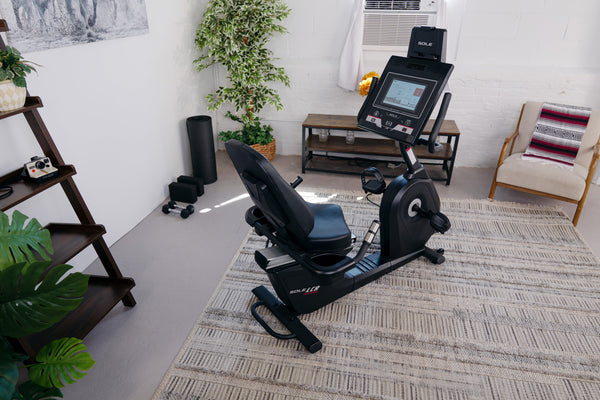
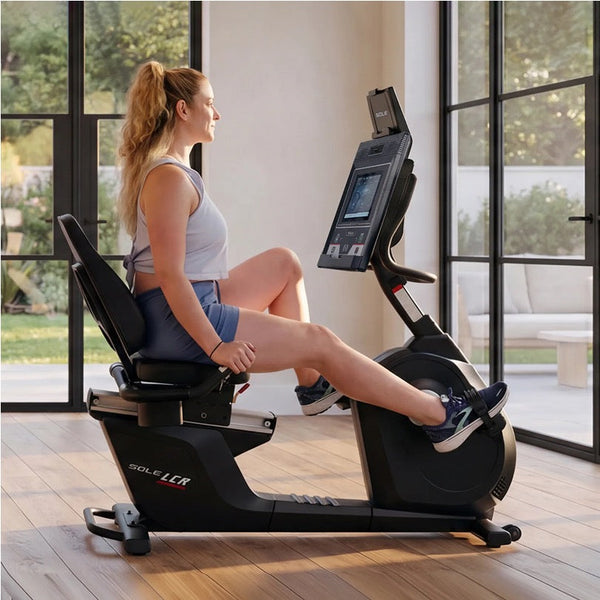
The SOLE LCB upright bike suits steady home cardio with 40 electromagnetic resistance levels, an adjustable gel seat for longer rides, and free SOLE+ app workouts with no subscription.
*Note: SOLE does not manufacture or sell air bikes. This is an independent review of a product for comparison purposes.
How Do You Choose an Exercise Bike for Home Cardio?
The right exercise bike depends on whether you want controlled, steady resistance or effort-driven intensity that scales with how hard you push.
People often compare upright bikes and air bikes only by how tough the pedaling feels, which overlooks bigger differences in resistance mechanics, joint stress, and whole-body engagement that determine which bike fits a specific training goal.
The real difference shows up in programming. Steady-state workouts respond best to consistent, predictable resistance, while interval training rewards resistance that rises and falls with your own output.
|
Smooth, Silent Rides for Every Fitness Level. Premium Home Fitness Bikes!
 Choose Your Perfect Style: Why Choose SOLE Exercise Bikes: ✓ Whisper-quiet magnetic resistance won't disturb others 30-Day Money-Back Guarantee: Love it or return it, no questions asked. |
What Are Upright Bikes and Air Bikes?

Upright bikes mimic outdoor cycling with resistance you choose, while an air bike’s fan responds to how hard you pedal.
What Is an Upright Bike?
An upright bike is built to feel like a regular outdoor bicycle, with the pedals positioned directly under your body rather than out in front of you. You can ride it seated for a relaxed, steady pace or, on many models, stand on the pedals to push harder, similar to climbing a hill on a road bike.
Most upright bikes rely on magnetic resistance, where magnets are positioned around a metal flywheel. The closer those magnets move toward the flywheel, the tougher the pedal stroke becomes, and that resistance is typically set with a knob or digital console buttons rather than by your pedaling effort.
What Is an Air Bike?
An air bike, sometimes called a fan bike, replaces the metal flywheel with a large fan that spins as you pedal. Instead of turning a dial to pick a resistance level, the fan itself decides how hard the ride feels based on your effort.
Most air bikes have no preprogrammed resistance levels and no knob to twist, though a few hybrid models add a dial with magnetic levels on top of the fan. The harder and faster you pedal, the more air the fan has to push, so resistance climbs automatically the moment you speed up and eases off the instant you slow down.
Differences Between Upright Bikes and Air Bikes
How They Work
An upright bike creates resistance through a magnetic system, where magnets surround a metal flywheel and move closer to it or are electronically strengthened as you increase the setting.
You control that resistance directly with a knob or through digital console buttons, which means the difficulty stays fixed at whatever level you choose until you change it again. This setup produces a smooth, consistent pedal stroke with virtually no mechanical noise, since there's no friction between moving parts.
An air bike uses a large fan that spins faster the harder and faster you pedal. On most air bikes, there's no preset resistance level to select because the fan responds in real time to your effort: pedaling slowly feels light, while pedaling quickly makes the fan push back with noticeably more force.
Muscles Worked
Riding an upright bike concentrates most of the work on your lower body, targeting the calves, hamstrings, and quadriceps with every rotation. Your core and glutes also stay engaged to keep you stable on the seat, especially if you stand to pedal during harder efforts, which many models allow.
An air bike recruits those same leg muscles, but it adds an upper-body component. Most air bikes come with handles that move in sync with the pedals, so pushing and pulling them brings the biceps, triceps, and shoulders into the workout alongside the legs.
Noise Level
Upright bikes with magnetic resistance run nearly silently because the magnets never touch the flywheel, so there’s no friction or grinding as you ride. That makes them easy to use early in the morning, late at night, or in shared spaces without disturbing anyone.
Air bikes get louder as you pedal faster, since the fan has to move more air to keep up. A gentle warm-up stays fairly quiet, but sprint intervals produce a steady whoosh that can carry through walls and floors.
Best Training Style
Upright bikes suit steady-state cardio, endurance rides, and structured workouts where you want to hold or repeat a specific intensity. Because the resistance stays where you set it, tracking progress from one week to the next is simple.
Air bikes suit HIIT, sprint intervals, and conditioning circuits where effort changes quickly. Resistance climbs the moment you push harder and drops the moment you ease off, so short, all-out efforts feel natural.
Pros of Upright Bikes and Air Bikes

Upright bikes give quiet, repeatable low-impact rides, while air bikes suit sprint intervals and keep you cool with their fan.
Upright Bike Pros
-
Delivers a low-impact cardio workout that keeps stress off the ankles, knees, and hips compared to running or jumping.
-
Provides smooth, nearly silent resistance thanks to the magnetic flywheel system.
-
Strengthens the legs and core while supporting a familiar, bicycle-like riding posture.
-
Allows precise control over resistance through a knob or console, making it easy to repeat specific workout intensities.
Air Bike Pros
-
Engages both the upper and lower body at once through moving handles paired with pedals.
-
Scales resistance automatically based on effort, removing the need to manually adjust settings mid-workout.
-
Generates a cooling breeze from the fan, which helps riders stay comfortable during intense sessions.
Cons of Upright Bikes and Air Bikes
Upright Bike Cons
-
Places pressure on the hands and wrists over longer sessions, since body weight rests partly on the handlebars.
-
Works the upper body very little, so riders who want full-body conditioning need separate strength training.
-
Resistance doesn’t rise automatically with effort, so sprint intervals require changing levels mid-effort.
-
Many models need a nearby power outlet, which limits where the bike can be placed.
Air Bike Cons
-
Gets louder as pedaling speed increases, which can make it a poor fit for apartments or shared living spaces where quiet workouts matter.
-
Lacks adjustable resistance levels on most models, so riders can’t dial in a fixed difficulty the way they can on a magnetic system.
-
Can feel punishing during all-out sessions, since the only way to ease resistance is to slow down.
Upright Bike vs Air Bike: Comparison Table
|
Feature |
Upright Bike |
Air Bike |
|
Resistance Type |
Magnetic |
Fan-based |
|
How Resistance Is Adjusted |
Knob or console setting |
Automatically by pedaling effort |
|
Upper-Body Involvement |
Minimal |
Significant, through moving handles |
|
Noise Level |
Nearly silent |
Increases with pedaling speed |
|
Power Source |
Electrical outlet (varies by model) |
No outlet needed (console typically runs on batteries) |
|
Console |
Varies by model; typically tracks time, distance, calories, and heart rate |
Varies by model; typically tracks time, distance, calories, and heart rate |
|
Best Use |
Steady-state cardio and controlled intensity |
HIIT, intervals, and max-effort sprints |
Train Steadily at Home on the SOLE LCB Upright Bike

The SOLE LCB combines 40 electromagnetic resistance levels, a 10.1-inch touchscreen, and a lifetime frame warranty for consistent home rides.
Upright bikes and air bikes split on one core question: do you want resistance you set, or resistance your effort creates? Air bikes reward short, all-out intervals and full-body work, while upright bikes favor quiet, low-impact sessions you can repeat at the same intensity week after week.
For riders who value that consistency, the SOLE LCB upright bike pairs 40 levels of electromagnetic resistance with a 10.1-inch touchscreen that tracks every ride, built-in cooling fans that keep you comfortable on longer sessions, and a 350-pound weight capacity. With our 30-day satisfaction guarantee and lifetime frame warranty, you can try the SOLE LCB upright bike at home and see how it fits your routine.
Frequently Asked Questions (FAQs)
Is an air bike harder than an upright bike?
Not by default, since both bikes are only as hard as the rider makes them. An air bike tends to feel tougher at full effort because the fan keeps pushing back as you speed up. An upright bike stays at the level you select, so the challenge grows when you raise it.
Is an upright bike good for beginners?
Yes, an upright bike is an easy place to start because the seated position feels like riding a regular bicycle. You can start at a low resistance level and increase it gradually, letting new riders build fitness at a pace their legs and joints can comfortably handle.
Can I carry out HIIT on an upright bike?
Yes. Upright bikes handle interval training well: alternate short bursts of hard pedaling with easier recovery periods. The main difference is that you raise and lower resistance yourself through a knob or console, whereas an air bike’s resistance scales automatically with your effort.
Do air bikes need to be plugged in?
Most air bikes don’t need to be plugged in, since the fan generates resistance purely from pedaling effort and the console typically runs on batteries. That makes them easy to place anywhere in a home gym without worrying about nearby power access.
Does the SOLE LCB require a workout subscription?
No, the SOLE LCB includes free access to the SOLE+ app, with no monthly subscription required. The bike's touchscreen also supports Wi-Fi and screen mirroring, so riders can follow guided workouts on the built-in display or mirror content from their own device without paying recurring fees.
*Disclaimer: Products and prices mentioned in this article are accurate as of the date of publication and are subject to change. Please visit the official SOLE website for the most current information.